500 bhp in a std comp cossie


Thread Starter
PassionFord Post Whore!!
Joined: Jun 2003
Posts: 3,744
Likes: 0
From: Exeter

Yes - that would be my understanding of it. Basically, the more defined sites that you can program, the less interpolation that is required, and as such, the less compromise.
Even so, this ultimately can only make the best use of the area within physics. As such, once the optimum boost level is achieved at a given compression ratio, the only solution left irrespective of the map will be to drop the compression ratio to increase the power (given that we are not increasing capacity etc etc etc)
Nice site that one Gareth! The colours are quite useful on the maps to assist in visualising the map!
I have an S8 on the shelf somewhere upstairs - I had a quick play with it, and whilst I never got to the point where I felt comfortable using it on the car, I at least got a very general idea on how the map works.
I think that the mapping itself is a subject in its own right, which Stu recently did a great write up in the Fast Ford Techincal section, so I wont go over old ground.
That said, I note that the more modern engines use a combination of Mass Air flow meters as well as MAP sensors. I believe that some of the Scoobies use this setup? Or is it that the MAF is there in replacement of the MAP.
Having discussed the subject further, I can now see the benefits of the MAF over the MAP, as it is measuring the volume of air, as opposed to the blocked air (boost). I guess that this would lead to more accurate maping.
My confusion is that a number of people I know that tune their Scoobies have removed the MAF in favour of the MAP. Why is this?
JJ
Even so, this ultimately can only make the best use of the area within physics. As such, once the optimum boost level is achieved at a given compression ratio, the only solution left irrespective of the map will be to drop the compression ratio to increase the power (given that we are not increasing capacity etc etc etc)
Nice site that one Gareth! The colours are quite useful on the maps to assist in visualising the map!
I have an S8 on the shelf somewhere upstairs - I had a quick play with it, and whilst I never got to the point where I felt comfortable using it on the car, I at least got a very general idea on how the map works.
I think that the mapping itself is a subject in its own right, which Stu recently did a great write up in the Fast Ford Techincal section, so I wont go over old ground.
That said, I note that the more modern engines use a combination of Mass Air flow meters as well as MAP sensors. I believe that some of the Scoobies use this setup? Or is it that the MAF is there in replacement of the MAP.
Having discussed the subject further, I can now see the benefits of the MAF over the MAP, as it is measuring the volume of air, as opposed to the blocked air (boost). I guess that this would lead to more accurate maping.
My confusion is that a number of people I know that tune their Scoobies have removed the MAF in favour of the MAP. Why is this?
JJ



Professional Waffler

Joined: May 2003
Posts: 30,980
Likes: 9
From: barry-south wales
a small turbo escort uses both mas and map
right,,,, a map based system,,, if nothing changes to effect the VE of the engine, and the ecu was calibrated correctly in the first place great system
advantage to map,, theres nothing restricing the intake volume, disadvantage, will no adjust for slight changes in VE without a re-calibration
right MAF systems,,, these actualy measure the airflow though the engine, so can alter for slight changes in VE as these will be measured changes,, but sadly we have a slight restriction in our inlet system
right,,,, a map based system,,, if nothing changes to effect the VE of the engine, and the ecu was calibrated correctly in the first place great system
advantage to map,, theres nothing restricing the intake volume, disadvantage, will no adjust for slight changes in VE without a re-calibration
right MAF systems,,, these actualy measure the airflow though the engine, so can alter for slight changes in VE as these will be measured changes,, but sadly we have a slight restriction in our inlet system


JJ, you are getting there now mate, I will correct a few things tomorrow if I get a chance before I leave for the ring, as TBH I cant be arsed getting technical at midnight, lol
If not, I'll speak to you on the phone tomorrow perhaps.
If not, I'll speak to you on the phone tomorrow perhaps.
Professional Waffler
Joined: May 2003
Posts: 30,980
Likes: 9
From: barry-south wales
Originally Posted by JjCoDeX75
you will still inevitably reach a point when you can no longer advance the engine enough to compensate. At this point, it wont matter how good the ECU is.

Thread Starter
PassionFord Post Whore!!
Joined: Jun 2003
Posts: 3,744
Likes: 0
From: Exeter
Yes that makes perfect sense!
So it all starts fitting together. The MAP is as you rightly say capable of measuring the boost with little inteference to the overall air flow itself, and so long as the map is set up correctly for the car, there is no reason why it should be changed.
The MAF by definition has to measure the flow of air and as such may in themselves reduce the VE!
Cool - I understood that in record time!
Right lets turn to fuelling.
In a different thread, I questioned why some cars need larger fuel injectors than other. for example, my 550cc injectors on my cossie more than adequately flow enough fuel for any power that I am currently running - ie about 400bhp ideally.
However, if you wanted to achieve that kind of power in other cars, then you would need larger injector sizes to get the same power. As I understand it, this relates to the pressure of the fuel rail. It kinda boils down to the same thing as the VE v Boost - it is a measure of how much flow against maximum size??
Given the above, I note that in cosworth land, people rarely change the fuel pressure. I wonder why this is - is it because ford just got it right - and if so, why is the jap world different?
JJ
So it all starts fitting together. The MAP is as you rightly say capable of measuring the boost with little inteference to the overall air flow itself, and so long as the map is set up correctly for the car, there is no reason why it should be changed.
The MAF by definition has to measure the flow of air and as such may in themselves reduce the VE!
Cool - I understood that in record time!
Right lets turn to fuelling.
In a different thread, I questioned why some cars need larger fuel injectors than other. for example, my 550cc injectors on my cossie more than adequately flow enough fuel for any power that I am currently running - ie about 400bhp ideally.
However, if you wanted to achieve that kind of power in other cars, then you would need larger injector sizes to get the same power. As I understand it, this relates to the pressure of the fuel rail. It kinda boils down to the same thing as the VE v Boost - it is a measure of how much flow against maximum size??
Given the above, I note that in cosworth land, people rarely change the fuel pressure. I wonder why this is - is it because ford just got it right - and if so, why is the jap world different?
JJ
Professional Waffler
Joined: May 2003
Posts: 30,980
Likes: 9
From: barry-south wales
ahhh right,,, here goes
firstly engine have different BSFC
"brake specific fuel consumption"
this is a measurement how how efficent the engine is at turning fuel into power, so fuel consution devided by power
right injectors differential pressures
the higher this is,,,, the more the injector will flow for a given injector opening time ,, if cause this is upper and lower limits to this
firstly engine have different BSFC
"brake specific fuel consumption"
this is a measurement how how efficent the engine is at turning fuel into power, so fuel consution devided by power
right injectors differential pressures
the higher this is,,,, the more the injector will flow for a given injector opening time ,, if cause this is upper and lower limits to this
Thread Starter
PassionFord Post Whore!!
Joined: Jun 2003
Posts: 3,744
Likes: 0
From: Exeter
Originally Posted by GARETH T
Originally Posted by JjCoDeX75
you will still inevitably reach a point when you can no longer advance the engine enough to compensate. At this point, it wont matter how good the ECU is.
 I knew I would get it the wrong way round!!!!!
 Reference to fuel, yes I remember you explaining this to me before - IIRC the type of injector also has an effect here.
Going back to the BSFC - lets focus on this for a moment. given that we have taken our standard engine, and potentially changed the compression ratio, the cam timing, the flow of air through the head, the VE and the turbo etc, I am mindful to wonder whether we have now changed our BSFC. If not, then what exactly affects this?
Sorry if this is a dumb question
JJ
BSFC actually varies even based on different RPM points and different amounts of boost.
Its not just one fixed number that applies, its an entire graph.
Typically most changes will make it better in some places and worse in others.
Its not just one fixed number that applies, its an entire graph.
Typically most changes will make it better in some places and worse in others.
Thread Starter
PassionFord Post Whore!!
Joined: Jun 2003
Posts: 3,744
Likes: 0
From: Exeter
Originally Posted by Chip-3Door
BSFC actually varies even based on different RPM points and different amounts of boost.
Its not just one fixed number that applies, its an entire graph.
Typically most changes will make it better in some places and worse in others.
Its not just one fixed number that applies, its an entire graph.
Typically most changes will make it better in some places and worse in others.
Right - yes that makes sense. Given that very very little (if anything) is linear in engine design, why should BSFC be different.
Even so, if the BSFC accounts for the different amount of fuel required to create power, if we substantially change the specification of the engine as above, why is the BSFC effectively not requiring alteration of the fuelling pressure etc?
JJ
Originally Posted by JjCoDeX75
Originally Posted by Chip-3Door
BSFC actually varies even based on different RPM points and different amounts of boost.
Its not just one fixed number that applies, its an entire graph.
Typically most changes will make it better in some places and worse in others.
Its not just one fixed number that applies, its an entire graph.
Typically most changes will make it better in some places and worse in others.
Right - yes that makes sense. Given that very very little (if anything) is linear in engine design, why should BSFC be different.
Even so, if the BSFC accounts for the different amount of fuel required to create power, if we substantially change the specification of the engine as above, why is the BSFC effectively not requiring alteration of the fuelling pressure etc?
JJ
The fuelling on the engine is largely linked to the airflow, within 20% or so even comparing between full boost and cruise.
The BSFC though can vary greatly, but only typically if you get things badly wrong with the spec.
Any time you see massive heat its normally an indication you just wrecked your BSFC!
Thread Starter
PassionFord Post Whore!!
Joined: Jun 2003
Posts: 3,744
Likes: 0
From: Exeter
Okay, that makes sense - so I guess whilst we work to the right principals with our theoretical engine, then the BSFC should be constant.
Right - bed time - to be continued in the morining when my brain re-engages!
Thanks all who continue to contribue guys! Without the techhys, this would be just the rantings of a Building Surveyor!!
I will leave you with the following thought though.....
All we need is an engine that has variable compression, variable cam timing as well as lift etc, combined with our adjustable ports, and variable vein turbo, and possibly the most complicated map ever written - and we have the perfect engine!
JJ
Right - bed time - to be continued in the morining when my brain re-engages!
Thanks all who continue to contribue guys! Without the techhys, this would be just the rantings of a Building Surveyor!!
I will leave you with the following thought though.....
All we need is an engine that has variable compression, variable cam timing as well as lift etc, combined with our adjustable ports, and variable vein turbo, and possibly the most complicated map ever written - and we have the perfect engine!
JJ
Thread Starter
PassionFord Post Whore!!
Joined: Jun 2003
Posts: 3,744
Likes: 0
From: Exeter
Originally Posted by Chip-3Door
JJ, not with pistons going up and down we dont have, thats a terrible idea, a decent form of rotary engine would be far better!
I am too easily confused!!
JJ
Originally Posted by Chip-3Door
JJ, not with pistons going up and down we dont have, thats a terrible idea, a decent form of rotary engine would be far better!
 all four strokes of an engine in a line with no recieprecating parts
  - look at the power they make

With regard to modern ecu technology.....
There has been a bit of confusion here with regards the word resolution.
Yes, modern ecus have more mapping points as explained before but this
is nothing to do with resolution it just means you have more numbers in
the table(s) to play with to fine tune problem areas in the map.
Resolution is actually the accuracy and ability of the ignition and injectors
to be timed accurately and more at finer intervals.
All ecus are high speed (relatively ) computers with dedicated
timing hardware as part of the micro processor.
The hardware timer is continuously clocked at a speed depending on the
micro processor type and design.
(FYI This timer system is called input capture/output compare or TPU)
This timer is used to reference all measurements and outputs.
To some extent this timer can be rescaled to give different values but
the software ususally configures this for the following values
due to limitations of the design.
Here are the hardware timer values for some ecus....
Weber L1 - 8 Microseconds = 125,000 per second.
Weber L6 - 4 Microseconds = 250,000 per second.
Weber L8 - 4 Microseconds = 250,000 per second.
Weber P8 - 2 Microseconds = 500,000 per second.
SECS S8 - 0.05 Microseconds = 20,000,000 per second
As you can see above, as stuff gets newer, it gets faster and that means
better accuracy and stablity.
Ok, I now need to explain how this timing is used for the different ares....
FUELING
(keeping it simple and excluding corrections etc...)
(all calculations and figures are rough examples)
After calculating the map table point from RPM and LOAD (map/maf etc)
and then interpolating from the table points around it, a value is arrived at.
In Weber ecus this value is only a single byte which means it can only
have a data value of 0 to 255.
This means you ONLY have 256 possible injector times.
Now, as most injector duration ranges as from about 2 to 20 milliseconds
this means that you have a range of 18 milliseconds and...
18 milliseconds divide by 256 = 70 microseconds
As the hardware timer tuns faster than this actual reduced resolution,
we need another value in the software which is called the multiplier.
On weber ecus this is typically set to 32 or 64 microseconds to give us
our 256 possible injector values.
From this you can see that the weber system is only capable of a
reletively crude injector timing accuracy.
On small injectors this isnt too much of a problem as these large interval
steps only increase fuel slightly.
When larger injectors are added, you begin to loose accuracy.
Modern ecus have larger map table values and using the S8 as an example,
it has a word value (as apposed to a byte) to store the fuel value
which has 65336 combinations allowing the multiplier to be smaller
giving better resolution.
IGNITION
This is where modern ecus have the biggest edge.
The above map table data size problems apply to ignition table values aswell
but the real gain is that the higher timer speeds in moder ecus allow
greater ignition timing accuracy especially at higher RPMs.
The ignition angle is calculated from the map and the current time it
takes between 2 crank teeth is measured.
This crank time is then divided by the number of degrees advance
required and a second timer is loaded with this new value.
When this second timer has gone to zero, the ignition coil is fired.
The higher the RPM the less time there is to divide into ignition advance
degrees which reduces accuracy.
As the timer runs faster, you have more resolution to be accurate in
a modern ecu.
As an example the L8 has 0.2 degrees map resolution but at high rpm
at around 5000 rpm the actual possible error value from the desired angle
is could be as high as 1.5 degrees !!!!!
As (for example) the S8 has a timer that is running 40 times faster, the
error is reduced by the same factor size.
This means it has a mappable accuracy of 0.1 degrees right upto its
12000 rpm designed rev limit.
SUMARY
WIth regards to injector accuracy, this makes only a minor problem for
large injectors on systems mapped by people who pay attention to detail
on older ecus.
With ignition accuracy, this means the det limit can be mapped too more
precisely and a reasonable accurate comfort zone added.
Although high timer resolutions give advantages, the real advantage of
modern ecus are accesability, extra features etc.....
*** I have used the S8 as an example as I have no direct experience of
the internal workings of any other high speed modern ecu that I am able
to publish without upsetting someones copyright LOL.

There has been a bit of confusion here with regards the word resolution.
Yes, modern ecus have more mapping points as explained before but this
is nothing to do with resolution it just means you have more numbers in
the table(s) to play with to fine tune problem areas in the map.
Resolution is actually the accuracy and ability of the ignition and injectors
to be timed accurately and more at finer intervals.
All ecus are high speed (relatively
) computers with dedicatedtiming hardware as part of the micro processor.
The hardware timer is continuously clocked at a speed depending on the
micro processor type and design.
(FYI This timer system is called input capture/output compare or TPU)
This timer is used to reference all measurements and outputs.
To some extent this timer can be rescaled to give different values but
the software ususally configures this for the following values
due to limitations of the design.
Here are the hardware timer values for some ecus....
Weber L1 - 8 Microseconds = 125,000 per second.
Weber L6 - 4 Microseconds = 250,000 per second.
Weber L8 - 4 Microseconds = 250,000 per second.
Weber P8 - 2 Microseconds = 500,000 per second.
SECS S8 - 0.05 Microseconds = 20,000,000 per second
As you can see above, as stuff gets newer, it gets faster and that means
better accuracy and stablity.
Ok, I now need to explain how this timing is used for the different ares....
FUELING
(keeping it simple and excluding corrections etc...)
(all calculations and figures are rough examples)
After calculating the map table point from RPM and LOAD (map/maf etc)
and then interpolating from the table points around it, a value is arrived at.
In Weber ecus this value is only a single byte which means it can only
have a data value of 0 to 255.
This means you ONLY have 256 possible injector times.
Now, as most injector duration ranges as from about 2 to 20 milliseconds
this means that you have a range of 18 milliseconds and...
18 milliseconds divide by 256 = 70 microseconds
As the hardware timer tuns faster than this actual reduced resolution,
we need another value in the software which is called the multiplier.
On weber ecus this is typically set to 32 or 64 microseconds to give us
our 256 possible injector values.
From this you can see that the weber system is only capable of a
reletively crude injector timing accuracy.
On small injectors this isnt too much of a problem as these large interval
steps only increase fuel slightly.
When larger injectors are added, you begin to loose accuracy.
Modern ecus have larger map table values and using the S8 as an example,
it has a word value (as apposed to a byte) to store the fuel value
which has 65336 combinations allowing the multiplier to be smaller
giving better resolution.
IGNITION
This is where modern ecus have the biggest edge.
The above map table data size problems apply to ignition table values aswell
but the real gain is that the higher timer speeds in moder ecus allow
greater ignition timing accuracy especially at higher RPMs.
The ignition angle is calculated from the map and the current time it
takes between 2 crank teeth is measured.
This crank time is then divided by the number of degrees advance
required and a second timer is loaded with this new value.
When this second timer has gone to zero, the ignition coil is fired.
The higher the RPM the less time there is to divide into ignition advance
degrees which reduces accuracy.
As the timer runs faster, you have more resolution to be accurate in
a modern ecu.
As an example the L8 has 0.2 degrees map resolution but at high rpm
at around 5000 rpm the actual possible error value from the desired angle
is could be as high as 1.5 degrees !!!!!
As (for example) the S8 has a timer that is running 40 times faster, the
error is reduced by the same factor size.
This means it has a mappable accuracy of 0.1 degrees right upto its
12000 rpm designed rev limit.
SUMARY
WIth regards to injector accuracy, this makes only a minor problem for
large injectors on systems mapped by people who pay attention to detail
on older ecus.
With ignition accuracy, this means the det limit can be mapped too more
precisely and a reasonable accurate comfort zone added.
Although high timer resolutions give advantages, the real advantage of
modern ecus are accesability, extra features etc.....
*** I have used the S8 as an example as I have no direct experience of
the internal workings of any other high speed modern ecu that I am able
to publish without upsetting someones copyright LOL.
Thread Starter
PassionFord Post Whore!!
Joined: Jun 2003
Posts: 3,744
Likes: 0
From: Exeter
Originally Posted by RWD_cossie_wil
Originally Posted by Chip-3Door
JJ, not with pistons going up and down we dont have, thats a terrible idea, a decent form of rotary engine would be far better!
all four strokes of an engine in a line with no recieprecating parts - look at the power they make Okey dokey - shall be get cracked back into it - I know that some of our tech chaps will be Ringbound, so lets take advantage of them whilst they are still here!
Can we focus in a little on the cam timing? I want to see if we can shed a little light on this area of tuning.
Lets create another hypothetical. We have agreed now the following;
1. The bottom end is now configured for mildly low compression (i dunno say 7.2:1 - Does that sound about right?) All else is std - stroke, piston size, cc etc.
2. The clyinder head has been mildly ported - lets say equivalent to a Norris Stage 1?
3. The Turbocharger at the moment is to be say a T38 (I guess with a 0.63 zorst housing IIRC). I know that the popular choice would be the T4, but bear with me
4. The fuelling and mapping is a given, and will be correct for whatever setup we finally work with.
Now you will note that we havent referred to the cams as such. Having built my virtual engine, I now have a Boost threshold of shall we say 4000rpm or there abouts, and it is proving to be very unresponsive off boost. The car owner (Mr Blobby) has asked that Jacobs independent car tuners (patent pending)
set up his car to if possible reduce the boost threshold, and improve the off boost running.So where do we start?
JJ
Originally Posted by JjCoDeX75
Right (for the second time due to a PHP Critical Error  )
)
I had a chat with Chip on the dog and bone, and he has attempted to explain the difference between various compression ratios. I will attempt to explain to you as best as I can.
Hopefully the resident experts will correct the bits that I get wrong!
The constants and assumtions
We will assume that the engine in question had a fixed number of cylinders, as well as stroke, and the number of cylinders is likewise fixed.
What is compression ratio
If I understand it, the compression ratio is effectively dictated by the amount of space at TDC. If you lower the compression ratio, then you are effectively slightly increasing this space.
)I had a chat with Chip on the dog and bone, and he has attempted to explain the difference between various compression ratios. I will attempt to explain to you as best as I can.
Hopefully the resident experts will correct the bits that I get wrong!
The constants and assumtions
We will assume that the engine in question had a fixed number of cylinders, as well as stroke, and the number of cylinders is likewise fixed.
What is compression ratio
If I understand it, the compression ratio is effectively dictated by the amount of space at TDC. If you lower the compression ratio, then you are effectively slightly increasing this space.
(Swept + Unswept) / Unswept
Unswept is the bit above the piston (including piston dish and the gasket as well as the volume of the head)
Swept is the volume displaced by the piston as it moves from bottom to top, so 500cc in the case of a 2000cc engine (YB is actually a touch under 2000cc)
Swept is calculated as Stroke * Bore * Bore * Pi
One of the advantages of the lower compression ratio is that it permits a greater Volumetric Efficiency (VE) (made by the effective increased area).
Please note that the volumetric efficiency is not improved by simply lowering the compression ratio - it merely allows for an improved VE if other things are changed.
Please note that the volumetric efficiency is not improved by simply lowering the compression ratio - it merely allows for an improved VE if other things are changed.
So the CR does not in any way effect the VE (slightly untrue actually, there is a TINY reduction in VE when you drop the CR, which is most effected at the top of the rev range)
So your comment of allowing other things to be changed would on a turbo engine typically mean that more boost would be safe without risking det, and its from this increased boost that the VE improvement comes.
The pros and cons of different ratios
First the pros - one of the most significant improvements is that the car is now able to run more advance without leading to detonation. Chip came up with a really useful way of visualising it.
Imagine that your car in std compression with say a T34 turbo. Currently it can work satisfactorily with say 1.5 bar of boost without danger of detonation (when properly set up). As you RAISE the compression ratio, eventually you will get to a point where you can no longer advance the engine enough to run that same level of boost.
First the pros - one of the most significant improvements is that the car is now able to run more advance without leading to detonation. Chip came up with a really useful way of visualising it.
Imagine that your car in std compression with say a T34 turbo. Currently it can work satisfactorily with say 1.5 bar of boost without danger of detonation (when properly set up). As you RAISE the compression ratio, eventually you will get to a point where you can no longer advance the engine enough to run that same level of boost.
The reverse and opposite is therefore true.
The second benefit is more subtle. As I understand it, a higher compression ratio car achieves power at a higher rpm. On the cosworth engine, the safe maximum realistic RPM is approx 8000rpm. Given this, when attempting to reach a certain amount of power, the compression ratio therefore needs to be lowered to allow for the intended power level to be reached.
So if we want big power figures within a fixed amount of rpm (ie we cant get it by carrying the torque on till 10,000 rpm as there are mechanical limits) then it means that we need to alter the CR to allow us to generate more torque reliabley per cycle so that we can get the power we want within the fixed number of cycles per minute we are limited to.
Second, the cons.
If you simply change the compression ratio and stuff a large turbo on the side of the engine, you will increase the power lever achieved by the engine based on the above.
If you simply change the compression ratio and stuff a large turbo on the side of the engine, you will increase the power lever achieved by the engine based on the above.
BUT
Because the compression ratio has been reduced, at lower speeds, the engine needs to flow more air to run properly.
Because the compression ratio has been reduced, at lower speeds, the engine needs to flow more air to run properly.
Now given that the cams in the engine are basically set up for the factory compression ratio, they do not optimise our new - lower compression ratio.
It is because of this that the timing of the cams needs to be amended to reflect the change in the CR.
it is THIS that tends to make the difference between a good low comp engine, and a bad low comp engine.
Lets pause here, and make sure that what I have above is correct (cue all resident experts!)
Originally Posted by JjCoDeX75
Originally Posted by RWD_cossie_wil
Originally Posted by Chip-3Door
JJ, not with pistons going up and down we dont have, thats a terrible idea, a decent form of rotary engine would be far better!
all four strokes of an engine in a line with no recieprecating parts - look at the power they make Okey dokey - shall be get cracked back into it - I know that some of our tech chaps will be Ringbound, so lets take advantage of them whilst they are still here!
Can we focus in a little on the cam timing? I want to see if we can shed a little light on this area of tuning.
Lets create another hypothetical. We have agreed now the following;
1. The bottom end is now configured for mildly low compression (i dunno say 7.2:1 - Does that sound about right?) All else is std - stroke, piston size, cc etc.
2. The clyinder head has been mildly ported - lets say equivalent to a Norris Stage 1?
3. The Turbocharger at the moment is to be say a T38 (I guess with a 0.63 zorst housing IIRC). I know that the popular choice would be the T4, but bear with me
4. The fuelling and mapping is a given, and will be correct for whatever setup we finally work with.
Now you will note that we havent referred to the cams as such. Having built my virtual engine, I now have a Boost threshold of shall we say 4000rpm or there abouts, and it is proving to be very unresponsive off boost. The car owner (Mr Blobby) has asked that Jacobs independent car tuners (patent pending)
set up his car to if possible reduce the boost threshold, and improve the off boost running.So where do we start?
JJ
So, after our sombering acceptance, we look first at altering the lobe centre angle of the cams so that we can improve the bottom end response with the existing hardware (well, other than the addition of a set of vernier pulleys), a couple of degrees can make a big difference here.
with regards to where we go next with cams, well, it depends what cams are fitted, because if its the standard ones, you are pretty stuffed really, as you arent going to get the top end response if you go any more mild than that.
So i would imagine in this instance, if the cams are "wrong" its because mr blobby has read that BD16s make good power and has slipped a set of them in or similar.
But to answer the question you are trying to ask, the vital thing to getting good turbo spooling is to hit it with short sharp pulses low down where you have limited airflow, so a short duration camshaft is the order of the day here as a longer duration one will dampen the effect.
Thread Starter
PassionFord Post Whore!!
Joined: Jun 2003
Posts: 3,744
Likes: 0
From: Exeter
Firstly - Simon - What a fantasitc little write up on ECUs! Top top write up! That one came up whilst I was still posting!
Chip - Thanks mate - those clarifications are important, as it allows anyone else to see where my understanding is erroneous!
As far as my ability to learn is concerned - I am a great believer that the ability of an individual to learn is far more dependent on those that are teaching - so thanks to you and to all others for taking the time!
So I have two ways to go now :-
1. further into cam timing and shaping (I will need to visit this again at some point)
2. I read an interesting article in EVO about the new Koenigseg (add the necessary letters as required) - which is designed to run on BioEthanol. I would like to discuss the pros and cons of alternative fuels in our high power engine
Your choice guys
JJ
That one came up whilst I was still posting!Chip - Thanks mate
- those clarifications are important, as it allows anyone else to see where my understanding is erroneous!As far as my ability to learn is concerned - I am a great believer that the ability of an individual to learn is far more dependent on those that are teaching - so thanks to you and to all others for taking the time!
So I have two ways to go now :-
1. further into cam timing and shaping (I will need to visit this again at some point)
2. I read an interesting article in EVO about the new Koenigseg (add the necessary letters as required) - which is designed to run on BioEthanol. I would like to discuss the pros and cons of alternative fuels in our high power engine
Your choice guys
JJ
Sadly mate, with regards to cams, you arent going to get much further on here talking generally, its only by actually getting stuck in and trying different cams back to back on the specific engine spec you are interested in and making slight changes in LSA etc that you are going to learn more about that.
Thread Starter
PassionFord Post Whore!!
Joined: Jun 2003
Posts: 3,744
Likes: 0
From: Exeter
Originally Posted by Chip-3Door
Sadly mate, with regards to cams, you arent going to get much further on here talking generally, its only by actually getting stuck in and trying different cams back to back on the specific engine spec you are interested in and making slight changes in LSA etc that you are going to learn more about that.
I think what I will do now is sit down, consider everything that has been said, and see if I can write a summary - this will help to see if I got it, and also should prevent us from repeating ourselves.
JJ
Professional Waffler
Joined: May 2003
Posts: 30,980
Likes: 9
From: barry-south wales
Originally Posted by Electronic
With regard to modern ecu technology.....
There has been a bit of confusion here with regards the word resolution.
Yes, modern ecus have more mapping points as explained before but this
is nothing to do with resolution it just means you have more numbers in
the table(s) to play with to fine tune problem areas in the map.
Resolution is actually the accuracy and ability of the ignition and injectors
to be timed accurately and more at finer intervals.
There has been a bit of confusion here with regards the word resolution.
Yes, modern ecus have more mapping points as explained before but this
is nothing to do with resolution it just means you have more numbers in
the table(s) to play with to fine tune problem areas in the map.
Resolution is actually the accuracy and ability of the ignition and injectors
to be timed accurately and more at finer intervals.
I was also referring to map resolution.
But I agree its much more than that, just being able to use high impedance very quick injectors these days for example makes for better options than when it was almost a case of greys or nothing!
But I agree its much more than that, just being able to use high impedance very quick injectors these days for example makes for better options than when it was almost a case of greys or nothing!

Thread Starter
PassionFord Post Whore!!
Joined: Jun 2003
Posts: 3,744
Likes: 0
From: Exeter
Originally Posted by foreigneRS
Originally Posted by JjCoDeX75
I know that some of our tech chaps will be Ringbound
Thread Starter
PassionFord Post Whore!!
Joined: Jun 2003
Posts: 3,744
Likes: 0
From: Exeter
Just a quicky
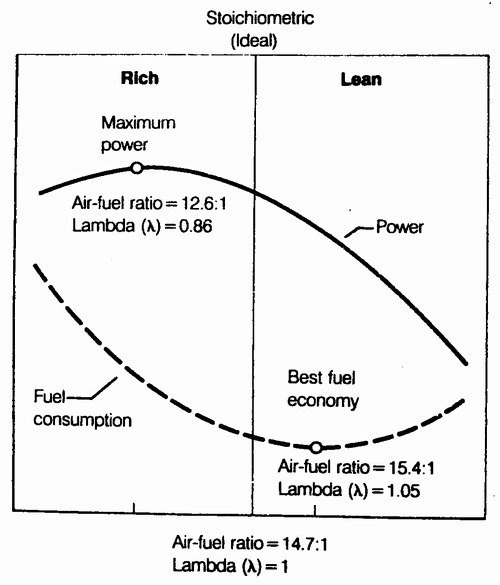
Why is it that when the turbo charger is operating at boost that the Stoichiometry figure for AF is disregarded for a richer mix? (ie 14.7:1 becomes 11:1)
Is it because of the temperature increase that occurs?
Thanks
JJ
Why is it that when the turbo charger is operating at boost that the Stoichiometry figure for AF is disregarded for a richer mix? (ie 14.7:1 becomes 11:1)
Is it because of the temperature increase that occurs?
Thanks
JJ
Stoich is still 14.7, thats still the "chemically correct" mixture.
But that would be too hot a burn, so is no use, and would not give good power, so is no use.
12.5/12.6 is the point of peak power, this is what you want to be running if you are able to without heat issues, on a YB though, high 11s is as close as most people go for safety reasons.
But that would be too hot a burn, so is no use, and would not give good power, so is no use.
12.5/12.6 is the point of peak power, this is what you want to be running if you are able to without heat issues, on a YB though, high 11s is as close as most people go for safety reasons.
Thread Starter
PassionFord Post Whore!!
Joined: Jun 2003
Posts: 3,744
Likes: 0
From: Exeter
Originally Posted by Chip-3Door
Stoich is still 14.7, thats still the "chemically correct" mixture.
But that would be too hot a burn, so is no use, and would not give good power, so is no use.
12.5/12.6 is the point of peak power, this is what you want to be running if you are able to without heat issues, on a YB though, high 11s is as close as most people go for safety reasons.
But that would be too hot a burn, so is no use, and would not give good power, so is no use.
12.5/12.6 is the point of peak power, this is what you want to be running if you are able to without heat issues, on a YB though, high 11s is as close as most people go for safety reasons.
Cheers
JJ
Originally Posted by JjCoDeX75
Originally Posted by Chip-3Door
Stoich is still 14.7, thats still the "chemically correct" mixture.
But that would be too hot a burn, so is no use, and would not give good power, so is no use.
12.5/12.6 is the point of peak power, this is what you want to be running if you are able to without heat issues, on a YB though, high 11s is as close as most people go for safety reasons.
But that would be too hot a burn, so is no use, and would not give good power, so is no use.
12.5/12.6 is the point of peak power, this is what you want to be running if you are able to without heat issues, on a YB though, high 11s is as close as most people go for safety reasons.
Cheers
JJ
14.7 is fine for light loads, 15.2 is perfect for economy.