


CVH High Compression Build


Thread Starter
15000
Joined: Sep 2018
Posts: 16
Likes: 0
From: Wisconsin
 CVH High Compression Build
Hello, got a series of 1.6s and a 1.9 to build up all NA
My 1.9 EFI HO is around 9.2:1 compression but I'd like to raise it to 9.5 or higher. However I can't find 12:1 pistons anymore, it seems a 1.6 head on it can get me closer to 10:1 - or more if I shave the head and deck but I don't really want to, or is that my only hope????
I also have some 1.6s to build up in a similar fashion, a couple are the North American HO motors already with 9:1 compression but I'd love to have more - again, without shaving blocks or heads..... I'm told 1.3 CVH pistons will get me up to 11:1 but I can't find those to save my life
My 1.9 EFI HO is around 9.2:1 compression but I'd like to raise it to 9.5 or higher. However I can't find 12:1 pistons anymore, it seems a 1.6 head on it can get me closer to 10:1 - or more if I shave the head and deck but I don't really want to, or is that my only hope????
I also have some 1.6s to build up in a similar fashion, a couple are the North American HO motors already with 9:1 compression but I'd love to have more - again, without shaving blocks or heads..... I'm told 1.3 CVH pistons will get me up to 11:1 but I can't find those to save my life

Advanced PassionFord User

Joined: Nov 2005
Posts: 1,922
Likes: 43
From: Bavaria
European spec 1.3 and 1.6 pistons were the same iirc, the only difference was the crankshaft.
Rising the compression from 9.2 to 9.5? Get your head skimmed and fit an adjustable camshaft pulley.
Rising the compression from 9.2 to 9.5? Get your head skimmed and fit an adjustable camshaft pulley.
Thread Starter
15000
Joined: Sep 2018
Posts: 16
Likes: 0
From: Wisconsin
Rumor has it that the 1.3 piston is the same in every way but has a taller dome/crown for more compression, they say if you find those you'll be at 11:1.
I'm trying to avoid the vernier cam (but it is inevitable) because the 1981-1990 North American 1.6 and 1.9 are square tooth vs every other CVH ever has round teeth - and CVH vernier cams only come as round tooth except one extremely rare Ford performance cam sprocket. Which wouldn't be a problem but the 81-90 cars use an entirely different water pump than every other CVH so changing from square to round isn't easy.
Maybe I can take a stock one into a machine shop and have more keyways cut like the Motorsport cam sprocket I mentioned.
I'm trying to avoid the vernier cam (but it is inevitable) because the 1981-1990 North American 1.6 and 1.9 are square tooth vs every other CVH ever has round teeth - and CVH vernier cams only come as round tooth except one extremely rare Ford performance cam sprocket. Which wouldn't be a problem but the 81-90 cars use an entirely different water pump than every other CVH so changing from square to round isn't easy.
Maybe I can take a stock one into a machine shop and have more keyways cut like the Motorsport cam sprocket I mentioned.

PassionFord Post Whore!!
iTrader: (1)
Joined: Jan 2006
Posts: 5,412
Likes: 186
From: Norfolk Drives: Couple of Fords
My worry would be whether the pistons could take that jump in compression, as you're probably stretching them quite a long way past what they're designed for.
Is there any reason you want to keep the CVH? A Zetec/Duratec would be much easier...
Is there any reason you want to keep the CVH? A Zetec/Duratec would be much easier...
Thread Starter
15000
Joined: Sep 2018
Posts: 16
Likes: 0
From: Wisconsin
Well that would be no different that shaving the head with stock pistons. Ford used to sell 12.3:1 cast pistons for the 1.6, cast was good enough for them it should be good enough for me (until one adds boost of course)
I've looked into Duratecs, they're awfully nice but their trannys here in the states are crap..... The 2006+ autos are alright but the earlier ones are junk, also all of the manuals are geared too darn tall and really hard to find. And lastly the Duratec trannys are all pretty weak, these old MTXs are really hardy.
I've thought about the Zetec swap but the only one worth doing is the SVT Focus swap - which are pretty hard to come by. Any other Zetec will cost you more to swap than it would to get the same power from a CVH.
I'd like to stay carbureted with these too for my resto-mods, I have a very rare Ford EXP to completely rebuild and it will appear totally stock for shows but I want it to be capable of sharing the roads with modern cars so the 65hp 1.6 CVH and 4-speed is getting bumped up to a 140-150hp 1.9 CVH and 5-speed so continuous highway speeds of 70mph is no issue.
I'd have more time and money wrapped up in swapping, praying it all fits and works right than I would at custom ordering pistons for a CVH knowing that with bike carbs, more compression, header, porting, and better cam I can have the same 160hp.
I've looked into Duratecs, they're awfully nice but their trannys here in the states are crap..... The 2006+ autos are alright but the earlier ones are junk, also all of the manuals are geared too darn tall and really hard to find. And lastly the Duratec trannys are all pretty weak, these old MTXs are really hardy.
I've thought about the Zetec swap but the only one worth doing is the SVT Focus swap - which are pretty hard to come by. Any other Zetec will cost you more to swap than it would to get the same power from a CVH.
I'd like to stay carbureted with these too for my resto-mods, I have a very rare Ford EXP to completely rebuild and it will appear totally stock for shows but I want it to be capable of sharing the roads with modern cars so the 65hp 1.6 CVH and 4-speed is getting bumped up to a 140-150hp 1.9 CVH and 5-speed so continuous highway speeds of 70mph is no issue.
I'd have more time and money wrapped up in swapping, praying it all fits and works right than I would at custom ordering pistons for a CVH knowing that with bike carbs, more compression, header, porting, and better cam I can have the same 160hp.
Last edited by 1982 EXPert; Jan 30, 2020 at 02:14 PM.
Advanced PassionFord User
Joined: Nov 2005
Posts: 1,922
Likes: 43
From: Bavaria
This is how adjustable camshaft pulleys also were made in the 80's and 90's. Mine was second hand and all the threads were broken. And as I had a lot of standard ones lying around...
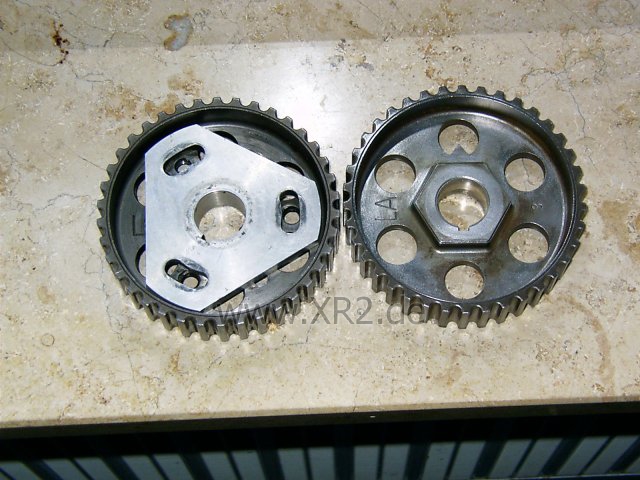
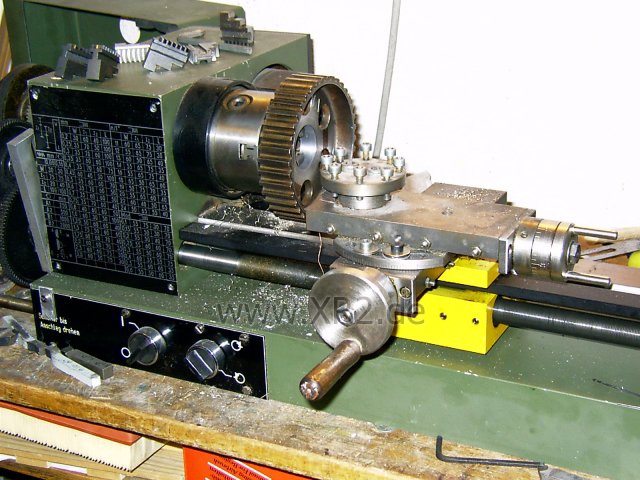


You might just need a decent CNC shop...
You might just need a decent CNC shop...
Last edited by XR2; Jan 30, 2020 at 08:46 PM.
Trending Topics
Too many posts.. I need a life!!


Joined: Feb 2006
Posts: 795
Likes: 26
From: Canada
The power gain from 9.2 to even 10:1 is minimal. You will likely end up with a power loss. Dome piston design and hemi head is very prone to detonation.
Cylinder head work - by someone who knows what they are doing will help.
Dual weber intake manifold also will add power.
Adjustable cam gear- perhaps, but why?
Are you changing camshaft?
The UK camshafts will not work in US 1.9 head. You will have to use a 1.6 head to use UK cams. (The camshaft journal sizes were changed on the 1.9.)
Steps I would take:
Ported cylinder head
Header with larger exhaust piping diameters.
Intake manifold - dual weber or individual bike carbs (if you are familiar with tuning them).
Camshaft change (if using 1.6 head) Do not go crazy on camshaft timing either.
Cheers!!
Cylinder head work - by someone who knows what they are doing will help.
Dual weber intake manifold also will add power.
Adjustable cam gear- perhaps, but why?
Are you changing camshaft?
The UK camshafts will not work in US 1.9 head. You will have to use a 1.6 head to use UK cams. (The camshaft journal sizes were changed on the 1.9.)
Steps I would take:
Ported cylinder head
Header with larger exhaust piping diameters.
Intake manifold - dual weber or individual bike carbs (if you are familiar with tuning them).
Camshaft change (if using 1.6 head) Do not go crazy on camshaft timing either.
Cheers!!
Thread Starter
15000
Joined: Sep 2018
Posts: 16
Likes: 0
From: Wisconsin
Hi Canada, I've been following your work closely and quietly!
I'm well-versed in the 1.6 vs 1.9 head & cam differences, got a bunch of each
To settle some confusion here's the build list I'm going for with my 1.9:
Stock 1987ish 1.9 EFI HO block
Stock 1987ish 1.9 EFI HO crank
Stock rods, forged might not be necessary
Hopefully higher domed pistons for about 10.5:1 (preferably forged since I'll probably have to custom order)
Thinner performance headgasket
Ported 1.9 EFI HO head with valve job (stock valve sizes) - not shaved, yet
Custom roller cam since the EFI HO roller cam can't be found anywhere but in parts cars..... Roller crankshaft is a must because I'm tired of seeing destroyed flat lifters and cam lobes :/
Roller rockers
Stronger/double valve springs if needed
Titanium spring retainers
Maybe stainless flat-top valves
Bike carbs with custom manifold - I'm a powersports mechanic, I have many on hand and can tune any with ease
1.9 EFI HO header (or a custom replica with mandrel bends instead)
Vernier cam sprocket
Vacuum & mechanical actuated distributor - a friend just found out how to adjust the vacuum advance/retard
All and all I'd really like 150hp, and I don't foresee any issues getting there. That would get my EXP up to snuff with all the other traffic on the interstate for any periods of time.
I was never too worried about specific cam timing until recently, for custom/performance cams it's a must wether you're turbo'd or not - especially if you're shaving the head or block's deck. And for stock cams a vernier pulley/sprocket could go a long way because TRUE TDC isn't always what it aught'a be, my friend found out his 1.6 crank sprocket had a poorly-cut keyway on the crank sprocket. His cam was probably 4 degrees off just because of that, and that's not taking into the account that the head/deck heights aren't exactly "X" and then a different headgasket changes "X" too.
I haven't done the math yet but shaving the head down to the max (something like 0.100" is the max cut) retards your cam timing about 4 degrees which will limit your top-end performance, retarded any more and it will hardly run much past idle. Lucky for us if you happen to be 4 degrees retarded you can turn that into 5.5 degrees advanced by moving the sprocket forward by one whole tooth (each tooth is 9.5 degrees of timing) but that's till too far advanced for many cams so it won't idle well but will help your top-end performance, but not as much as a well-timed camshaft.
I'm not a turbo pro but retarding the cam is supposed to really help build boost, so they actually do come in handy more than we initially realize.
Compression will get you far if you have the spark and appropriate fuel to match, the naturally aspirated CVHs love it when you tweak the timing and if you can run only 91 octane or higher you can advance your spark pretty far without pinging. The 1.6 HO had more compression than the base 1.6 (9:1 instead of 8.5:1), a header, a slightly larger carb, and a slightly larger camshaft to gain 10hp more over the base 1.6 on 87 octane, with 91 octane and some more timing advance you could notice a big difference between them. I have no doubt I can produce similar results with my motors. Ford says the CVH is safe up to 11:1 with normal pump gas, they used to offer 12.3:1 pistons but race fuel would definitely be desired lol
I'm well-versed in the 1.6 vs 1.9 head & cam differences, got a bunch of each
To settle some confusion here's the build list I'm going for with my 1.9:
Stock 1987ish 1.9 EFI HO block
Stock 1987ish 1.9 EFI HO crank
Stock rods, forged might not be necessary
Hopefully higher domed pistons for about 10.5:1 (preferably forged since I'll probably have to custom order)
Thinner performance headgasket
Ported 1.9 EFI HO head with valve job (stock valve sizes) - not shaved, yet
Custom roller cam since the EFI HO roller cam can't be found anywhere but in parts cars..... Roller crankshaft is a must because I'm tired of seeing destroyed flat lifters and cam lobes :/
Roller rockers
Stronger/double valve springs if needed
Titanium spring retainers
Maybe stainless flat-top valves
Bike carbs with custom manifold - I'm a powersports mechanic, I have many on hand and can tune any with ease
1.9 EFI HO header (or a custom replica with mandrel bends instead)
Vernier cam sprocket
Vacuum & mechanical actuated distributor - a friend just found out how to adjust the vacuum advance/retard
All and all I'd really like 150hp, and I don't foresee any issues getting there. That would get my EXP up to snuff with all the other traffic on the interstate for any periods of time.
I was never too worried about specific cam timing until recently, for custom/performance cams it's a must wether you're turbo'd or not - especially if you're shaving the head or block's deck. And for stock cams a vernier pulley/sprocket could go a long way because TRUE TDC isn't always what it aught'a be, my friend found out his 1.6 crank sprocket had a poorly-cut keyway on the crank sprocket. His cam was probably 4 degrees off just because of that, and that's not taking into the account that the head/deck heights aren't exactly "X" and then a different headgasket changes "X" too.
I haven't done the math yet but shaving the head down to the max (something like 0.100" is the max cut) retards your cam timing about 4 degrees which will limit your top-end performance, retarded any more and it will hardly run much past idle. Lucky for us if you happen to be 4 degrees retarded you can turn that into 5.5 degrees advanced by moving the sprocket forward by one whole tooth (each tooth is 9.5 degrees of timing) but that's till too far advanced for many cams so it won't idle well but will help your top-end performance, but not as much as a well-timed camshaft.
I'm not a turbo pro but retarding the cam is supposed to really help build boost, so they actually do come in handy more than we initially realize.
Compression will get you far if you have the spark and appropriate fuel to match, the naturally aspirated CVHs love it when you tweak the timing and if you can run only 91 octane or higher you can advance your spark pretty far without pinging. The 1.6 HO had more compression than the base 1.6 (9:1 instead of 8.5:1), a header, a slightly larger carb, and a slightly larger camshaft to gain 10hp more over the base 1.6 on 87 octane, with 91 octane and some more timing advance you could notice a big difference between them. I have no doubt I can produce similar results with my motors. Ford says the CVH is safe up to 11:1 with normal pump gas, they used to offer 12.3:1 pistons but race fuel would definitely be desired lol
Advanced PassionFord User
Joined: Nov 2005
Posts: 1,922
Likes: 43
From: Bavaria
I've had about 10,3:1 compression on a 1.6 CVH MFI. No issues even when using standard 95 ROZ/RON petrol. And it's not about the power output, it's mostly about the torque. And to really gain power a combination of more than one modifications is a must.
Forget that carburettor fairytales. That's stone-age engineering. Bike carbs might be a common mod, but it's the same like any other carb conversion. Especially when the conversion is done by cutting the standard inlet manifold and connection the carbs with silicone hoses to it.
Bike throttle bodies? Not the worst idea, but it still will take a lot of work, money and skill to make them fit properly. And after all... all these mods work well with high revs and that's something the CVH wasn't made for. So sticking with a proper manifold and one throttle works well on most road-going engines.
Roller rockers and roller rocker arms? These will produce a lot of play, high power output engines in Europe never use things like that and the only standard engine over here fitted with roller rockers was the 1,8 CVH in the Ford Sierra. Problems with followers and cam lobes? This is a very common problem for CVHs with aftermarket (tuning) camshafts. When you think about buying a camshaft that needs to use things like cam lube or running-in oil... throw them as far as you can. That's crap and a sign of ancient machinery. Manufacturers/tuning companies with proper machines will be able to grind and harden the lobes perfectly so you just have to put the camshaft and followers in with standard engine oil. Start the engine and have fun. Leading companies like AVL Schrick are able to produce such camshaft since the 1950s or 1960s.
Adjustable camshaft pulley? Always a good idea. Even with a standard camshaft you'll be able to find a few horses as you can eliminiate factory tolerances, especially on such an old engine.
I doubt the head design of the CVH will be able to cope with high compression rates of 11:1 and more, no matter which kind of petrol you're using. Aim for a healthy 10:1, with a proper camshaft, manifold, exhaust, inlet and head work you won't have any problems reaching the 150 hp you're aiming for.
And as we're now in the computer age also think about throwing out the mechanical distributor. Having a mappable injection system (with ignition) will give you much more power AND possibilities than tinkering with the vacuum advance of the dizzy (which isn't the only part that affects the ignition timing).
Forget that carburettor fairytales. That's stone-age engineering. Bike carbs might be a common mod, but it's the same like any other carb conversion. Especially when the conversion is done by cutting the standard inlet manifold and connection the carbs with silicone hoses to it.
Bike throttle bodies? Not the worst idea, but it still will take a lot of work, money and skill to make them fit properly. And after all... all these mods work well with high revs and that's something the CVH wasn't made for. So sticking with a proper manifold and one throttle works well on most road-going engines.
Roller rockers and roller rocker arms? These will produce a lot of play, high power output engines in Europe never use things like that and the only standard engine over here fitted with roller rockers was the 1,8 CVH in the Ford Sierra. Problems with followers and cam lobes? This is a very common problem for CVHs with aftermarket (tuning) camshafts. When you think about buying a camshaft that needs to use things like cam lube or running-in oil... throw them as far as you can. That's crap and a sign of ancient machinery. Manufacturers/tuning companies with proper machines will be able to grind and harden the lobes perfectly so you just have to put the camshaft and followers in with standard engine oil. Start the engine and have fun. Leading companies like AVL Schrick are able to produce such camshaft since the 1950s or 1960s.
Adjustable camshaft pulley? Always a good idea. Even with a standard camshaft you'll be able to find a few horses as you can eliminiate factory tolerances, especially on such an old engine.
I doubt the head design of the CVH will be able to cope with high compression rates of 11:1 and more, no matter which kind of petrol you're using. Aim for a healthy 10:1, with a proper camshaft, manifold, exhaust, inlet and head work you won't have any problems reaching the 150 hp you're aiming for.
And as we're now in the computer age also think about throwing out the mechanical distributor. Having a mappable injection system (with ignition) will give you much more power AND possibilities than tinkering with the vacuum advance of the dizzy (which isn't the only part that affects the ignition timing).
Thread Starter
15000
Joined: Sep 2018
Posts: 16
Likes: 0
From: Wisconsin
I think the 1.8 only had roller lifters & cam
The roller rockers will help reduce a lot of valvetrain weight and friction allowing for easier/faster reving. The biggest issue with the stock rockers is their crude pivot points, metal pivoting on metal that oil can't really get too so there's some friction there, enough that the pivoting surfaces polish each other and can wear the rocker arm thin in the center.
Next step is to reduce valve & spring retainer weight so it can not just rev easier/faster but to also limit valve float and valvetrain wear. The stems of the valves are under so much pressure from the valve springs and the rocker arm that they polish the end of the rocker arm and eventually wear it thin too.
This may be all little things but they add up to pain-staking futures in the issue that I want to avoid. All of this with a roller cam will make my 1.9 reliable and relatively maintenance free after break-in, just have to do regular oil changes and the timing belt every 50k - probably can go longer if I reduce all the valvetrain weight & friction but I won't have that many miles over 5 years so I'd be replacing my belt before then lol
At the end there won't be much play, the hydraulic roller lifters still take care of that but I'm hoping there's a way I can make them "anti-pumps" so at higher rpms they're not losing hydraulic pressure thus lowering valve lift
In the states we don't have much access to performance cams or modern replacement cams, OEM NOS cams can be found on eBay pretty cheap but eventually they eat up lifters are wear out there lobes. I can get nicer cams from the UK but I'd be paying $200 just for a (EU) stock-profile cam after shipping, I could go bigger but then it's costing me $350 at which point I can have one custom made here in the states to any spec I want.
I blame poor construction too, as a $50 replacement cam from 1980s Ford won't be incredible lol But there's a lot of strain on the valvetrain that I know can be improved upon to help eliminate the extreme lobe & lifter wear we see so often in the flat-tappet CVHs. But I'll be using roller cams in as many CVHs as I can, virtually no lobe/lifter wear, a lot less valvetrain friction, more lobe duration, more aggressive lobe ramps, the only downside is them not being solid tappets you might not be getting up to 9500rpm but 7500 is no issue.
Event hough it will probably be my biggest limiting factor, I think my vacuum & mechanical distributor will be fine with some careful tweeking of the vacuum diaphragm and tuning the counter weights & springs. I'm really trying to keep a stock appearance under the hood, everything I've mentioned so far can be and will be well-hidden under the stock valve cover, stock timing cover, and big stock oval air box in addition to my custom headers that will pass as late 1982 optional equipment. If I wasn't keeping a stock appearance a custom CDI or computer-mapping system would certainly be on my mind!
The roller rockers will help reduce a lot of valvetrain weight and friction allowing for easier/faster reving. The biggest issue with the stock rockers is their crude pivot points, metal pivoting on metal that oil can't really get too so there's some friction there, enough that the pivoting surfaces polish each other and can wear the rocker arm thin in the center.
Next step is to reduce valve & spring retainer weight so it can not just rev easier/faster but to also limit valve float and valvetrain wear. The stems of the valves are under so much pressure from the valve springs and the rocker arm that they polish the end of the rocker arm and eventually wear it thin too.
This may be all little things but they add up to pain-staking futures in the issue that I want to avoid. All of this with a roller cam will make my 1.9 reliable and relatively maintenance free after break-in, just have to do regular oil changes and the timing belt every 50k - probably can go longer if I reduce all the valvetrain weight & friction but I won't have that many miles over 5 years so I'd be replacing my belt before then lol
At the end there won't be much play, the hydraulic roller lifters still take care of that but I'm hoping there's a way I can make them "anti-pumps" so at higher rpms they're not losing hydraulic pressure thus lowering valve lift
In the states we don't have much access to performance cams or modern replacement cams, OEM NOS cams can be found on eBay pretty cheap but eventually they eat up lifters are wear out there lobes. I can get nicer cams from the UK but I'd be paying $200 just for a (EU) stock-profile cam after shipping, I could go bigger but then it's costing me $350 at which point I can have one custom made here in the states to any spec I want.
I blame poor construction too, as a $50 replacement cam from 1980s Ford won't be incredible lol But there's a lot of strain on the valvetrain that I know can be improved upon to help eliminate the extreme lobe & lifter wear we see so often in the flat-tappet CVHs. But I'll be using roller cams in as many CVHs as I can, virtually no lobe/lifter wear, a lot less valvetrain friction, more lobe duration, more aggressive lobe ramps, the only downside is them not being solid tappets you might not be getting up to 9500rpm but 7500 is no issue.
Event hough it will probably be my biggest limiting factor, I think my vacuum & mechanical distributor will be fine with some careful tweeking of the vacuum diaphragm and tuning the counter weights & springs. I'm really trying to keep a stock appearance under the hood, everything I've mentioned so far can be and will be well-hidden under the stock valve cover, stock timing cover, and big stock oval air box in addition to my custom headers that will pass as late 1982 optional equipment. If I wasn't keeping a stock appearance a custom CDI or computer-mapping system would certainly be on my mind!

Thread
Thread Starter
Forum
Replies
Last Post
street
Technical help Q & A
4
Apr 17, 2006 04:03 PM