


technical discussion on boost, and how its controlled


Thread Starter
Banned
Joined: Dec 2002
Posts: 142
Likes: 1
 technical discussion on boost, and how its controlled
Boost - what is it - how is it measured - why does it give power gains - how do turbos make boost? - how is it controlled
Ok, lets start at a very basic level here.
What is boost?
Boost is simply pressurised air present in the intake of an engine.
The fact that the air is pressurised means that it is denser, and therefore any given volume of it contains more air molecules than if it were not "boosted" up to a pressure above atmospheric.
Atmoshperic pressure is 1bar or 14.5 psi (actually a bar is 14.7 and people often confuse the two, but its not relevant to this dicussion really anyway!), therefore if we have no boost at all, we still have 1 bar of pressure in the inlet.
Why does it give more power?
Now assuming we produce .5 bar of boost, that means that potentially we have 50% more air going to enter our engine (feel free to ask questions on why its only potentially and not actually, but heat is basically the enemy here!)
Ok, so we know that boost is a cool thing to have cause its going to make our engine more effiecient at consuming air, which in turn means we can burn more fuel, so therefore make more power!
How do turbos make boost?
so where does this boost come from on a turbo car?
As an engine runs it generates a lot of exhaust gas, this is forced out of the engine under pressure.
This pressure is collected in a manifold and then forced through a turbo, as it goes through the turbo its made to spin a wheel (turbine) this wheel is then attached via a shaft to another wheel (compressor) so as the exhaust gas leaves it ends up spinning this compressor wheel.
The compressor wheel is housed in a sealed part of the turbo, and the input to this housing comes from the air filter (we dont want stones in our turbo!) and goes to the engine (via an intercooler in most cases)
So what happens is that the spinning of this wheel (its like a fan) produces boost in the inlet tract for the engine.
How is it controlled?
Inside the turbo there is a "wastegate", this is basically a circular bypass valve (typically the size of a 2p piece or so on smaller turbos), when this gate is opened it allows some of the exhaust gas to completely bybass the turbine housing and instead exit straight down the exhaust.
This valve remains shut initially, and is operated by a pressure controlled device called an actuator, basically pressure pressing on the actuator overcomes a spring and allows it open the wastegate, either partially or fully.
So in a very simple system, this is the only control that is present, it allows boost pressure to rise to a point, then it is held there via this mechanism.
So how do we control it on a more performance related application where we want to be able to raise boost levels?
Well basically nearly all boost control devices work in fundamentally the same way, they allow boost to leak from the actuator so that it doesnt get enough pressure to open.
So if we have a 10psi actuator, and we want 15psi of boost, we "bleed off" 5psi of pressure so that the actuator doesnt open until 15psi instead.
Future chapters still to come
Right, thats the very basic stuff, i will pop back and detail a bit more about:
wastegate creep
bleed valves
amal valves
external wastegates
manual boost controllers
But if in the meantime before i get a chance, someone else wants to have a pop at one or more of those chapters, then that would be fantastic
Ok, lets start at a very basic level here.
What is boost?
Boost is simply pressurised air present in the intake of an engine.
The fact that the air is pressurised means that it is denser, and therefore any given volume of it contains more air molecules than if it were not "boosted" up to a pressure above atmospheric.
Atmoshperic pressure is 1bar or 14.5 psi (actually a bar is 14.7 and people often confuse the two, but its not relevant to this dicussion really anyway!), therefore if we have no boost at all, we still have 1 bar of pressure in the inlet.
Why does it give more power?
Now assuming we produce .5 bar of boost, that means that potentially we have 50% more air going to enter our engine (feel free to ask questions on why its only potentially and not actually, but heat is basically the enemy here!)
Ok, so we know that boost is a cool thing to have cause its going to make our engine more effiecient at consuming air, which in turn means we can burn more fuel, so therefore make more power!
How do turbos make boost?
so where does this boost come from on a turbo car?
As an engine runs it generates a lot of exhaust gas, this is forced out of the engine under pressure.
This pressure is collected in a manifold and then forced through a turbo, as it goes through the turbo its made to spin a wheel (turbine) this wheel is then attached via a shaft to another wheel (compressor) so as the exhaust gas leaves it ends up spinning this compressor wheel.
The compressor wheel is housed in a sealed part of the turbo, and the input to this housing comes from the air filter (we dont want stones in our turbo!) and goes to the engine (via an intercooler in most cases)
So what happens is that the spinning of this wheel (its like a fan) produces boost in the inlet tract for the engine.
How is it controlled?
Inside the turbo there is a "wastegate", this is basically a circular bypass valve (typically the size of a 2p piece or so on smaller turbos), when this gate is opened it allows some of the exhaust gas to completely bybass the turbine housing and instead exit straight down the exhaust.
This valve remains shut initially, and is operated by a pressure controlled device called an actuator, basically pressure pressing on the actuator overcomes a spring and allows it open the wastegate, either partially or fully.
So in a very simple system, this is the only control that is present, it allows boost pressure to rise to a point, then it is held there via this mechanism.
So how do we control it on a more performance related application where we want to be able to raise boost levels?
Well basically nearly all boost control devices work in fundamentally the same way, they allow boost to leak from the actuator so that it doesnt get enough pressure to open.
So if we have a 10psi actuator, and we want 15psi of boost, we "bleed off" 5psi of pressure so that the actuator doesnt open until 15psi instead.
Future chapters still to come
Right, thats the very basic stuff, i will pop back and detail a bit more about:
wastegate creep
bleed valves
amal valves
external wastegates
manual boost controllers
But if in the meantime before i get a chance, someone else wants to have a pop at one or more of those chapters, then that would be fantastic

Thread Starter
Banned
Joined: Dec 2002
Posts: 142
Likes: 1
Cheers lads, the aim is definately to try and make things seems as simple as possible for people to understand, and to build up gradually then to a level that interests people who already know a bit.
Would be great for more people to join in with me and Stu in writing these though.
There are a LOT of good technical people on this site, so im sure some of them could do a really good job with this
Would be great for more people to join in with me and Stu in writing these though.
There are a LOT of good technical people on this site, so im sure some of them could do a really good job with this

PassionFord Post Whore!!
Joined: Apr 2004
Posts: 5,343
Likes: 0
From: Warsaw, Poland
chip-3door could you possibly explain how air-injectors work too? Nobody ever heard of those here, probably the only ones avalible were on early Grp A cars and those were always serviced by companies from abroad.
Oh..and do you know what kind of boost control is used on modern rallycars? I heard something that some of WRC cars don't even have wastegates, but even if they do, what do they use? SOme modern valves in a way of those on boost controllers?
Oh..and do you know what kind of boost control is used on modern rallycars? I heard something that some of WRC cars don't even have wastegates, but even if they do, what do they use? SOme modern valves in a way of those on boost controllers?

DEYTUKURJERBS
Joined: Apr 2004
Posts: 29,378
Likes: 1
From: North Korea
Originally Posted by Azrael
chip-3door could you possibly explain how air-injectors work too? Nobody ever heard of those here, probably the only ones avalible were on early Grp A cars and those were always serviced by companies from abroad.
Ie dont bleed off any air like bleed/amal valves, just stop airflow getting to the actuator/wastegate at all until a set pressure level is reached.
Trending Topics

PassionFord Post Whore!!
Joined: Apr 2004
Posts: 5,343
Likes: 0
From: Warsaw, Poland
Originally Posted by Itsmeagain
Originally Posted by Azrael
chip-3door could you possibly explain how air-injectors work too? Nobody ever heard of those here, probably the only ones avalible were on early Grp A cars and those were always serviced by companies from abroad.
Ie dont bleed off any air like bleed/amal valves, just stop airflow getting to the actuator/wastegate at all until a set pressure level is reached.
DEYTUKURJERBS
Joined: Apr 2004
Posts: 29,378
Likes: 1
From: North Korea
Originally Posted by Azrael
Originally Posted by Itsmeagain
Originally Posted by Azrael
chip-3door could you possibly explain how air-injectors work too? Nobody ever heard of those here, probably the only ones avalible were on early Grp A cars and those were always serviced by companies from abroad.
Ie dont bleed off any air like bleed/amal valves, just stop airflow getting to the actuator/wastegate at all until a set pressure level is reached.

Football Cwazy
Joined: Oct 2004
Posts: 9,553
Likes: 0
From: Redditch, Worcestershire
although you've touched on it there Chip, maybe more detail on what a turbo actually is
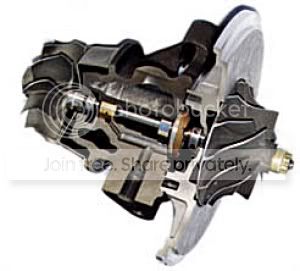
basically two Turbine wheels ( like propellers ) mounted on the end of a single shaft , at one end is the exhaust turbine (hot side), the other end is a compressor turbine (cold side )
on this picture ( with the compressor and exhaust housings removed), the larger wheel is the compressor and at the other end is the exhaust , the section between is known as the core, this contains the bearings, seals and galleries for the oil and water to run ( seperately of course ) . the shaft needs to spin dead centrally,if it didn't then it would probably result in a noisy whining turbo or worse, a broken turbo! the water and oil galleries are for lubrication and cooling.
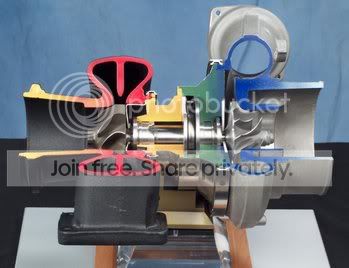
this is a similar picture with the housings attached.
basically two Turbine wheels ( like propellers ) mounted on the end of a single shaft , at one end is the exhaust turbine (hot side), the other end is a compressor turbine (cold side )
on this picture ( with the compressor and exhaust housings removed), the larger wheel is the compressor and at the other end is the exhaust , the section between is known as the core, this contains the bearings, seals and galleries for the oil and water to run ( seperately of course ) . the shaft needs to spin dead centrally,if it didn't then it would probably result in a noisy whining turbo or worse, a broken turbo! the water and oil galleries are for lubrication and cooling.
this is a similar picture with the housings attached.

Professional Waffler

Joined: May 2003
Posts: 30,980
Likes: 9
From: barry-south wales
Originally Posted by Azrael
Originally Posted by Itsmeagain
Originally Posted by Azrael
chip-3door could you possibly explain how air-injectors work too? Nobody ever heard of those here, probably the only ones avalible were on early Grp A cars and those were always serviced by companies from abroad.
Ie dont bleed off any air like bleed/amal valves, just stop airflow getting to the actuator/wastegate at all until a set pressure level is reached.
the propper name of this type of control is bleed on (or meter on)
there is alot of valves that can be used too meter this air and nor just "air injectors" theres lots of PWM valves out there

PassionFord Post Troll
Joined: Jul 2003
Posts: 2,582
Likes: 0
From: Suffolk
As requested by chip...... 
The Amal Valve.........
the Amal valve otherwise known as a Wastegate control solenoid is a control method for boost used on the weber marelli system as used on Cossie as well as other cars.
The Amal valve is basically a body with 3 ports.
1 port is an inlet
the other 2 are outlets. 1 goes to atmosphere and the other to the wastegate.
The valve works in a way whereby the inlet is connected only to the wastegate until the solenoid is energised at which point, the atmosphere port is also opened.
Inside is a small plunger and a spring housed around the solenoid itself.
With no power, the spring closes the plunger and covers an internal port (to atmos) and thus directs the air to the WG.
This works as a fail safe and means should you lose power to the amal the spring will close the plunger and air will be sent out of the WG port to wastegate to reduce boost.
Hence the 'click' you hear when you put power to the amal, its the plunger being pulled of its seat by the solenoid.
The solenoid part of the valve is pulsed on and off by the ecu itself.
this opens and closes the atmosphere port, thus introducing an air leak to atmosphere (boost increase as bleed is away from WG) The frequency is fixed however the ecu varies the duration of the pulse to effect the boost bleed normally at around 50%.
The boost level is sensed by the Map sensor and this in turn can allow the ecu to adjust the output signal to the amal so as to maintain the correct boost level.
this is also how the ecu can lower boost as the revs rise, as by the time the revs get to 6000rpm, the ecu is reducing boost to save the engine, and also does this by reference to the ACT, again to reduce boost.
Bleed valve......
Easy to follow on from the above.
So what is it?
basically its a very simple manual bleed control similar to the amal.
It consists of a body to which a hose can be connected to each end and has a variable orifice inline inside which bleeds some air away to atmosphere.
When fitted between the compressor and the wastegate, the orifice can be opened up bit by bit to decrease the boost in the line being sent to the WG.
Put simply the bigger the orifice the more air bleeds away to atmosphere, the less boost is felt by the WG hence higher boost pressure created.
Whilst this is simple in terms of usage, it does not provide any form of ecu control like the amal, and hence has no option to change boost pressure should the engine develope a potentially fatal fault or due to high acts.
The Amal Valve.........
the Amal valve otherwise known as a Wastegate control solenoid is a control method for boost used on the weber marelli system as used on Cossie as well as other cars.
The Amal valve is basically a body with 3 ports.
1 port is an inlet
the other 2 are outlets. 1 goes to atmosphere and the other to the wastegate.
The valve works in a way whereby the inlet is connected only to the wastegate until the solenoid is energised at which point, the atmosphere port is also opened.
Inside is a small plunger and a spring housed around the solenoid itself.
With no power, the spring closes the plunger and covers an internal port (to atmos) and thus directs the air to the WG.
This works as a fail safe and means should you lose power to the amal the spring will close the plunger and air will be sent out of the WG port to wastegate to reduce boost.
Hence the 'click' you hear when you put power to the amal, its the plunger being pulled of its seat by the solenoid.
The solenoid part of the valve is pulsed on and off by the ecu itself.
this opens and closes the atmosphere port, thus introducing an air leak to atmosphere (boost increase as bleed is away from WG) The frequency is fixed however the ecu varies the duration of the pulse to effect the boost bleed normally at around 50%.
The boost level is sensed by the Map sensor and this in turn can allow the ecu to adjust the output signal to the amal so as to maintain the correct boost level.
this is also how the ecu can lower boost as the revs rise, as by the time the revs get to 6000rpm, the ecu is reducing boost to save the engine, and also does this by reference to the ACT, again to reduce boost.
Bleed valve......
Easy to follow on from the above.
So what is it?
basically its a very simple manual bleed control similar to the amal.
It consists of a body to which a hose can be connected to each end and has a variable orifice inline inside which bleeds some air away to atmosphere.
When fitted between the compressor and the wastegate, the orifice can be opened up bit by bit to decrease the boost in the line being sent to the WG.
Put simply the bigger the orifice the more air bleeds away to atmosphere, the less boost is felt by the WG hence higher boost pressure created.
Whilst this is simple in terms of usage, it does not provide any form of ecu control like the amal, and hence has no option to change boost pressure should the engine develope a potentially fatal fault or due to high acts.

PassionFords Creator
iTrader: (12)
Joined: May 2003
Posts: 28,824
Likes: 95
From: Blackpool, UK Destination: Rev limiter
Jared, im going to edit your essay just to correct a few small points. I will highlight the changes and once you are happy with what i have changed, please reformat the text so its no longer highlightd and stays as your own essay 

PassionFords Creator
iTrader: (12)
Joined: May 2003
Posts: 28,824
Likes: 95
From: Blackpool, UK Destination: Rev limiter
Originally Posted by FastKA
Think a New section needs to be added where Chip can Spread his Tech knowledge, Bit Like a Haynes Manual
PassionFords Creator
iTrader: (12)
Joined: May 2003
Posts: 28,824
Likes: 95
From: Blackpool, UK Destination: Rev limiter
PassionFord Post Troll
Joined: Jul 2003
Posts: 2,582
Likes: 0
From: Suffolk
Originally Posted by Stu @ M Developments
Jared, im going to edit your essay just to correct a few small points. I will highlight the changes and once you are happy with what i have changed, please reformat the text so its no longer highlightd and stays as your own essay
And thanks


Thread
Thread Starter
Forum
Replies
Last Post
Mark RS
Ford RS Cosworth Parts for Sale
7
Oct 12, 2015 06:01 AM
Russ Payne
Ford Sierra/Sapphire/RS500 Cosworth
1
Sep 25, 2015 08:29 PM
