


Common rail diesels and NON common rail diesels....Whats the difference


Thread Starter
Chasing Radders
Joined: May 2003
Posts: 37,253
Likes: 2
From: WARWICK
 Common rail diesels and NON common rail diesels....Whats the difference
What is the difference between them both??????
Looking for a new runabout that will run any old shit i through in it......ie Veg oil ect ect.....
Just sold my TDDi Mondeo but want something that looks newer but can run different stuff without causeing any issues....
Looking at Vectra DTi's/Astra DTi's as they are non common rail....
Just got me thinking what is the difference
Looking for a new runabout that will run any old shit i through in it......ie Veg oil ect ect.....
Just sold my TDDi Mondeo but want something that looks newer but can run different stuff without causeing any issues....
Looking at Vectra DTi's/Astra DTi's as they are non common rail....
Just got me thinking what is the difference

Part of the Furniture
Joined: Oct 2011
Posts: 170
Likes: 4
From: Patras, Greece
common rail means the engine has a fuel rail so the injectors share a low pressure, and each one works as high pressure pump.
non common rail is when the engine has a single high pressure fuel pump that distributes fuel to the injectors at high pressure.
This in my mind can be cosidered a "mechanical" set up with all injectors doing pretty much the same, where as at the common rail systems every injector works indipendetly from the others, and as such, can be cotrolled indipendently.
Thats how trucks work and I don't think cars are much different in filosophy.
non common rail is when the engine has a single high pressure fuel pump that distributes fuel to the injectors at high pressure.
This in my mind can be cosidered a "mechanical" set up with all injectors doing pretty much the same, where as at the common rail systems every injector works indipendetly from the others, and as such, can be cotrolled indipendently.
Thats how trucks work and I don't think cars are much different in filosophy.

PassionFord Post Whore!!


Joined: Mar 2006
Posts: 4,928
Likes: 129
From: Lincs.
http://www.myarchive.us/richc/VW_TDI_with_PumpeDuse.pdf
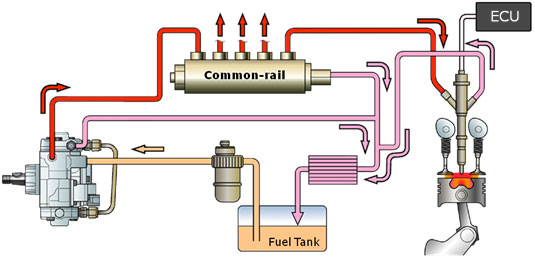
'True' common rail in my mind is when a single high pressure pump feeds a single (common) fuel rail , where the injector for each cylinder is piped from the rail, at pressures of up to 1600bar, then the engine PCM/ECM/ECU (whatever you like to call it) controls the injection duration/pilot injection and quantities electronically.
Last edited by GVK.; May 6, 2012 at 08:54 PM.

15K+ Super Poster!!
Joined: May 2003
Posts: 15,885
Likes: 17
From: Stockport, Cheshire
No time to explain now, sure someone will jump in, but modern CR is certainly not at low pressure! Also unit injectors are electronically controlled, a solenoid either allows the diesel to be injected or diverted.
Rick
Rick

Advanced PassionFord User
Joined: Apr 2009
Posts: 1,623
Likes: 16
From: Bridgend, South Wales
Common rail is where you have a rail with a constant pressure in it. This feeds the injectors constantly.
The injector is then opened with an electric pulse (In the case of a HDi engine it's 80v, little current).
A mechanically pumped engine is a much like a distributor in that it supplies each injector at the right time with the right amount of fuel.
Bare in mine that ANY diesel can run on WELL MADE bio. People who moan about issues running on Bio have been filling up with something a little dodgey.
Also if you want to run someone like pure vegtable oil you will need a Bosch Ve fuel pump and have an Indirectly injected engine.
Even if a direct injection lump has a bosch pump, running it on Veg can gum up the rings.
The injector is then opened with an electric pulse (In the case of a HDi engine it's 80v, little current).
A mechanically pumped engine is a much like a distributor in that it supplies each injector at the right time with the right amount of fuel.
Bare in mine that ANY diesel can run on WELL MADE bio. People who moan about issues running on Bio have been filling up with something a little dodgey.
Also if you want to run someone like pure vegtable oil you will need a Bosch Ve fuel pump and have an Indirectly injected engine.
Even if a direct injection lump has a bosch pump, running it on Veg can gum up the rings.

cossie fan (unluckerly)


Joined: Nov 2009
Posts: 9,798
Likes: 435
From: hampshire
common rail means the engine has a fuel rail so the injectors share a low pressure, and each one works as high pressure pump.
non common rail is when the engine has a single high pressure fuel pump that distributes fuel to the injectors at high pressure.
This in my mind can be cosidered a "mechanical" set up with all injectors doing pretty much the same, where as at the common rail systems every injector works indipendetly from the others, and as such, can be cotrolled indipendently.
Thats how trucks work and I don't think cars are much different in filosophy.
non common rail is when the engine has a single high pressure fuel pump that distributes fuel to the injectors at high pressure.
This in my mind can be cosidered a "mechanical" set up with all injectors doing pretty much the same, where as at the common rail systems every injector works indipendetly from the others, and as such, can be cotrolled indipendently.
Thats how trucks work and I don't think cars are much different in filosophy.
Part of the Furniture
Joined: Oct 2011
Posts: 170
Likes: 4
From: Patras, Greece
I have a few Scania 164's (DC1602 and DC 1601 engines) and all I mean by "low" is that it is lower than the actual pressure that the injectors discharge at. Obviously for it to work the "low" pressure is alot higher than the pressure of lets say the DSC 1413 and DSC 1415 that my older 144's engines use as a supply to the mechanical pump.
EDIT: 144 is the same truck, Scania 4 series but with a 14 liter engine, Euro 2
EDIT: 144 is the same truck, Scania 4 series but with a 14 liter engine, Euro 2
Last edited by William MK2 Cosworth; May 6, 2012 at 08:37 PM.
Trending Topics

C**t
Joined: Oct 2003
Posts: 7,998
Likes: 269
From: Norn Iron
Many have injector failures running on proper diesel nevermind alternatives.
Even some conventional diesel pumps/injectors dont like biodiesel. Some on the other hand will run on almost anything for a very long time with no problems.

could i sum it up by saying that the older style tddi ones are like the mechanical efi setups on the golks and escorts from years gone by and the tdci set up is like a regular normal efi setup with one rail supplying all the injectors?
almost like an old school dizzy vs coilpacks?
almost like an old school dizzy vs coilpacks?
C**t
Joined: Oct 2003
Posts: 7,998
Likes: 269
From: Norn Iron
Common rail is pretty much like a modern fuel injected car. A single fuel rail that supplies injectors at high pressure via the pump and electronically controlled injectors.
Older setups had a pump which controlled amount of fuel flow, then just blasted it to each injector as and when was appropriate. The old systems were totally mechanical, more recent stuff did have some degree of electronic control over the pump, but not the injectors.
Older setups had a pump which controlled amount of fuel flow, then just blasted it to each injector as and when was appropriate. The old systems were totally mechanical, more recent stuff did have some degree of electronic control over the pump, but not the injectors.
PassionFord Post Whore!!
Joined: Mar 2006
Posts: 4,928
Likes: 129
From: Lincs.

C**t
Joined: Oct 2003
Posts: 7,998
Likes: 269
From: Norn Iron
Some will run on almost anything, straight veggie oil, old oil, heating oil etc etc.
Some will shit the pump after a very short period of time.
I know a guy who tried once on his 306....turned out it had the wrong pump lol and it died after a few thousand miles running on veggie oil.
If you search SVO type forums I'm sure they can advise better.
But if you're talking red diesel type of thing. Red diesel is excellent quality fuel and any diesel engine will be happy on it.
By comparison over here anyway, buy white from a lot of garages and you havent a clue what your buying as it could simply be laundered diesel.
I'm sure the same thing goes on over there too.
As much I had disbelieved it before, early this year the place I was buying diesel from must have changed their supplier. MPG took a nose dive by about 12-15% ! Asda fuel was the same.
Switched to a different brand, and suddenly mpg was restored. And the original supplier certainly wasnt a cowboy outfit as I had been using them for months and all was fine.
Recently with current brand Ive been getting better mpg than Ive ever had. So even with legit white diesel, there really is a huge difference
PassionFord Post Whore!!
Joined: Mar 2006
Posts: 4,928
Likes: 129
From: Lincs.
Was chatting to an AA patrol guy last week about modern diesels breaking down (TDCI Mondeos for example)
I asked if he saw many problems with people running veg oil etc, he said "Loads"
He said he very often sees lumps of snot blocking up the filters and pipes etc.
I asked if he saw many problems with people running veg oil etc, he said "Loads"
He said he very often sees lumps of snot blocking up the filters and pipes etc.
C**t
Joined: Oct 2003
Posts: 7,998
Likes: 269
From: Norn Iron
Ive seen some diesel cars when you remove the fuel filter, both the filter and housing are totally full of crap. And this is modern cars.
No idea where they were buying fuel. In some way's it is little wonder the fragile common rail stuff can break down.
If you own one, you really need to be religious with the servicing. Especially fuel filters. More often than suggest by manufacturer can do no harm.
No idea where they were buying fuel. In some way's it is little wonder the fragile common rail stuff can break down.
If you own one, you really need to be religious with the servicing. Especially fuel filters. More often than suggest by manufacturer can do no harm.

Common rail is where the injectors share a common feed, either constant pressure or variable to govern RPM
Individual pump supplied injectors or SCROLL systems use an individual pump to supply fuel to the injectors.
The older scroll system is the best for junk fuel.
Individual pump supplied injectors or SCROLL systems use an individual pump to supply fuel to the injectors.
The older scroll system is the best for junk fuel.

PassionFords Creator
iTrader: (12)
Joined: May 2003
Posts: 28,824
Likes: 95
From: Blackpool, UK Destination: Rev limiter
Have a read of this article I wrote Tiff, it should answer most of your questions.
http://www.motorsport-developments.c...AF300_tech.pdf
http://www.motorsport-developments.c...AF300_tech.pdf
Part of the Furniture
Joined: Oct 2011
Posts: 170
Likes: 4
From: Patras, Greece
Its very entertaining to see what the difference in fuel quality will do to cosumption and pumps etc, as even the slightest hint of water will produce the slime and clog up everything!!
The only sollution I found after loads of problems, is getting the stuff straight from the refinery and having my own tank and pump.
Still here in Greece, every couple of months the rethink the ratio of ingridients, according to the bio-diesel's supply. When there is more biodiesel in the mix, my trucks tend to smoke more and consumption is worse.
The only sollution I found after loads of problems, is getting the stuff straight from the refinery and having my own tank and pump.
Still here in Greece, every couple of months the rethink the ratio of ingridients, according to the bio-diesel's supply. When there is more biodiesel in the mix, my trucks tend to smoke more and consumption is worse.
Common rail is pretty much like a modern fuel injected car. A single fuel rail that supplies injectors at high pressure via the pump and electronically controlled injectors.
Older setups had a pump which controlled amount of fuel flow, then just blasted it to each injector as and when was appropriate. The old systems were totally mechanical, more recent stuff did have some degree of electronic control over the pump, but not the injectors.
Older setups had a pump which controlled amount of fuel flow, then just blasted it to each injector as and when was appropriate. The old systems were totally mechanical, more recent stuff did have some degree of electronic control over the pump, but not the injectors.
Theres loads of common rail systems. Mechanical Unit injection (MUI) Hydraulic Electronic Unit Injection (HEUI's <-- Fucking shite nitmare) Electronic Unit Injection (EUI) is the most used.
The latest EUI has upto 6 strategy's which includes Pre and Post cycle injection cycles to clean combustion.
Some like the HEUI have ORS systems that inject a small ammount of engine oil into the fuel and a tank replenishes as required. It's all about extended oil changes = Money
Don't get me started about Dual Electronic Unit Injectors (DEUI) twin function Variable timing

I will get my coat.

Have a read of this article I wrote Tiff, it should answer most of your questions.
http://www.motorsport-developments.c...AF300_tech.pdf
http://www.motorsport-developments.c...AF300_tech.pdf

Any chance of getting a link to the EGR one, too?
PassionFords Creator
iTrader: (12)
Joined: May 2003
Posts: 28,824
Likes: 95
From: Blackpool, UK Destination: Rev limiter
Thread Starter
Chasing Radders
Joined: May 2003
Posts: 37,253
Likes: 2
From: WARWICK
Have a read of this article I wrote Tiff, it should answer most of your questions.
http://www.motorsport-developments.c...AF300_tech.pdf
http://www.motorsport-developments.c...AF300_tech.pdf
Cheers Stu....very interesting read.....


Regular Contributor
Joined: May 2008
Posts: 221
Likes: 0
defo not lol the vauxhall insignia's run at 1200psi when engine is running same as the astra j's with the same engine most diesel's run around 1000psi or more on common rails when the engine is running

Thread
Thread Starter
Forum
Replies
Last Post
wowk
General Car Related Discussion.
4
Mar 30, 2021 07:49 PM
SMILER258
Restorations, Rebuilds & Projects.
36
Sep 28, 2015 09:04 AM
