


Quarter Mile table entry - Reyland Sierra


Thread Starter
I've found that life I needed.. It's HERE!!
Joined: May 2003
Posts: 1,317
Likes: 2
From: Sidcup
 Quarter Mile table entry - Reyland Sierra
Not sure how to upload a time to the 1/4 mile table? Guessing it might be something to do with my gold membership lapsing?
If not, can someone important maybe add these figures to it?
Figures from Santa Pod on 14th Dec 2006
60ft 1.771
330ft 4.899
1/8th mile 7.459 @ 100.42mph
1000ft 9.574
1/4 mile 11.482 @ 124.70
bhp guess at between 450-500 @ flywheel on the day
The car was suffering from high charge temps (need a bigger intercooler) and I was suffering from the inability to find max boost on the 20odd position dial - no, it's not all the way at one end!
No nitrous
Just for those who may have been interested, I also had the Datron kit in the car. The figures were:
0-10mph 0.597sec
0-20mph 1.099sec
0-30mph 1.327sec
0-40mph 1.886sec
0-50mph 3.022sec
0-60mph 3.572sec
0-70mph 4.282sec
0-80mph 5.731sec
0-90mph 6.652sec
0-100mph 7.655sec
If not, can someone important maybe add these figures to it?
Figures from Santa Pod on 14th Dec 2006
60ft 1.771
330ft 4.899
1/8th mile 7.459 @ 100.42mph
1000ft 9.574
1/4 mile 11.482 @ 124.70
bhp guess at between 450-500 @ flywheel on the day
The car was suffering from high charge temps (need a bigger intercooler) and I was suffering from the inability to find max boost on the 20odd position dial - no, it's not all the way at one end!
No nitrous
Just for those who may have been interested, I also had the Datron kit in the car. The figures were:
0-10mph 0.597sec
0-20mph 1.099sec
0-30mph 1.327sec
0-40mph 1.886sec
0-50mph 3.022sec
0-60mph 3.572sec
0-70mph 4.282sec
0-80mph 5.731sec
0-90mph 6.652sec
0-100mph 7.655sec




PassionFord Post Whore!!
Joined: Oct 2003
Posts: 4,775
Likes: 0
From: S/E Kent, Thanet
Dan
As you might of guessed, you need your gold membership to make 'My car' in the Pf garage.
Cant you get Lee to do? If not i guess a 'mod' will do it.
ps, suffering ACT temps in December? could it not just be heat soak causing it?
i moved my ACT ecu sensor from the plenuim to a samco hose to stop this.
As you might of guessed, you need your gold membership to make 'My car' in the Pf garage.
Cant you get Lee to do? If not i guess a 'mod' will do it.
ps, suffering ACT temps in December? could it not just be heat soak causing it?
i moved my ACT ecu sensor from the plenuim to a samco hose to stop this.

Thread Starter
I've found that life I needed.. It's HERE!!
Joined: May 2003
Posts: 1,317
Likes: 2
From: Sidcup
Originally Posted by Fiecos Dan
suffering ACT temps in December? could it not just be heat soak causing it?
i moved my ACT ecu sensor from the plenuim to a samco hose to stop this.
i moved my ACT ecu sensor from the plenuim to a samco hose to stop this.
I'm going by the SPA temp probe on the exit of the intercooler. It says we've got a hotter than ideal charge, so I guess we need to make it cooler rather than try tricking things.
Originally Posted by Bosch-Man
...the 2wd exhaust manifold is a problem too....but atleast you was within the reliability range.
*the bait is cast

*the bait is cast
Trending Topics
Moving the ACT sensor can require a remap, so definately not an ideal solution to try and get lower numbers.
The temperature correction tables that have been mapped for the ACT calibrated as it is currently in its present location would not be correct for it moved somewhere else which will give a different reading for what is in reality still the same temperature of charge actually entering the head.
With regards to the manifold, they are well proven at far past the flow rate you require for the sort of BHP you are quoting there, but as always with any manifold you can never have too much data so EGT senders in each cylinder would be a cheap bit of worthwhile insurance IMHO.
The temperature correction tables that have been mapped for the ACT calibrated as it is currently in its present location would not be correct for it moved somewhere else which will give a different reading for what is in reality still the same temperature of charge actually entering the head.
With regards to the manifold, they are well proven at far past the flow rate you require for the sort of BHP you are quoting there, but as always with any manifold you can never have too much data so EGT senders in each cylinder would be a cheap bit of worthwhile insurance IMHO.


TBH I didn't think a intercooler would make that much difference on the 1/4 mile because there's only 11.4 seconds where heat exchange (air to air) can occure so it wouldn't make that much difference to your charge temps. I would think a charge cooler would be more suited (water to air) or am I way off?


Thread Starter
I've found that life I needed.. It's HERE!!
Joined: May 2003
Posts: 1,317
Likes: 2
From: Sidcup
Originally Posted by lead_foot
TBH I didn't think a intercooler would make that much difference on the 1/4 mile because there's only 11.4 seconds where heat exchange (air to air) can occure so it wouldn't make that much difference to your charge temps. I would think a charge cooler would be more suited (water to air) or am I way off?
Football Cwazy
Joined: Oct 2004
Posts: 9,553
Likes: 0
From: Redditch, Worcestershire
you could run both a large front mount like a Pro-Alloy,as well as a small chargecooler on the way into the inlet....would help massively IMO (Karl has something like that on his 3dr,there's pictures somewhere)
awesome times BTW,and on another note,i didn't like the new comps at Donno....sorry
awesome times BTW,and on another note,i didn't like the new comps at Donno....sorry
TBH I didnt think a intercooler would make that much difference on the 1/4 mile because theres only 11.4 seconds where heat exchange (air to air) can occure so it wouldnt make that much difference to your charge temps. I would think a charge cooler would be more suited (water to air) or am I way off?
The way they work is basically, the ally cools the charge, and the ambient air cools the ally.
During that 11 seconds, you are correct that there will not actually be a lot of transfer from ambient to the ally.
For this same reason, a charge cooler isnt as useful as you might think on the quarter, unless its packed with ice or some other method to get the core temp below ambient, as likewise there will be not enough time for the water to absorb heat from the ally core, so the only real advantage from the chargecooler would be a lack of heat soak from the radiator.
A larger cooler though would represent a bigger reservoir of coolness for the charge to be cooled by during the run, so its more useful in that respect and would be ideal if there is room for one.
Blasting the FMIC with a carbon dioxide extinguisher would give better results still though, and is the ideal choice for quarter mile use.
The way they work is basically, the ally cools the charge, and the ambient air cools the ally.
During that 11 seconds, you are correct that there will not actually be a lot of transfer from ambient to the ally.
For this same reason, a charge cooler isnt as useful as you might think on the quarter, unless its packed with ice or some other method to get the core temp below ambient, as likewise there will be not enough time for the water to absorb heat from the ally core, so the only real advantage from the chargecooler would be a lack of heat soak from the radiator.
A larger cooler though would represent a bigger reservoir of coolness for the charge to be cooled by during the run, so its more useful in that respect and would be ideal if there is room for one.
Blasting the FMIC with a carbon dioxide extinguisher would give better results still though, and is the ideal choice for quarter mile use.
Originally Posted by Renton
Originally Posted by lead_foot
TBH I didn't think a intercooler would make that much difference on the 1/4 mile because there's only 11.4 seconds where heat exchange (air to air) can occure so it wouldn't make that much difference to your charge temps. I would think a charge cooler would be more suited (water to air) or am I way off?
Originally Posted by pondscum
TBH I didnt think a intercooler would make that much difference on the 1/4 mile because theres only 11.4 seconds where heat exchange (air to air) can occure so it wouldnt make that much difference to your charge temps. I would think a charge cooler would be more suited (water to air) or am I way off?
The way they work is basically, the ally cools the charge, and the ambient air cools the ally.
During that 11 seconds, you are correct that there will not actually be a lot of transfer from ambient to the ally.
For this same reason, a charge cooler isnt as useful as you might think on the quarter, unless its packed with ice or some other method to get the core temp below ambient, as likewise there will be not enough time for the water to absorb heat from the ally core, so the only real advantage from the chargecooler would be a lack of heat soak from the radiator.
A larger cooler though would represent a bigger reservoir of coolness for the charge to be cooled by during the run, so its more useful in that respect and would be ideal if there is room for one.
The way they work is basically, the ally cools the charge, and the ambient air cools the ally.
During that 11 seconds, you are correct that there will not actually be a lot of transfer from ambient to the ally.
For this same reason, a charge cooler isnt as useful as you might think on the quarter, unless its packed with ice or some other method to get the core temp below ambient, as likewise there will be not enough time for the water to absorb heat from the ally core, so the only real advantage from the chargecooler would be a lack of heat soak from the radiator.
A larger cooler though would represent a bigger reservoir of coolness for the charge to be cooled by during the run, so its more useful in that respect and would be ideal if there is room for one.
I was thinking charge cooler and ice. But yeah i see a larger intercooler would have a larger reservoir for coolness.
Originally Posted by pondscum
Blasting the FMIC with a carbon dioxide extinguisher would give better results still though, and is the ideal choice for quarter mile use.
Thread Starter
I've found that life I needed.. It's HERE!!
Joined: May 2003
Posts: 1,317
Likes: 2
From: Sidcup
Originally Posted by pondscum
Blasting the FMIC with a carbon dioxide extinguisher would give better results still though, and is the ideal choice for quarter mile use.
The other thing that really holds the car back over the 1/4 is the synco gear box. On checking the Datron graphs it showed that each gear change cost around 0.4sec. A dog box on the other hand changes gear in around 0.1sec.
Doesn't take a genius to work out what sort of effect losing 0.9sec of gear changes time would have on the 1/4 mile time...
Well, it does actually cos the car would meed to be going a lot faster over the finish line if it was to get there .9sec earlier, but you know what I mean!
PS before people think 'I don't want that box then' it applies to all the Cossie 4WD syncro boxes I've checked the data on.
PPS Cheers for the good comments guys

PassionFord Post Whore!!
Joined: Oct 2003
Posts: 4,775
Likes: 0
From: S/E Kent, Thanet
Originally Posted by Renton
Originally Posted by Fiecos Dan
suffering ACT temps in December? could it not just be heat soak causing it?
i moved my ACT ecu sensor from the plenuim to a samco hose to stop this.
i moved my ACT ecu sensor from the plenuim to a samco hose to stop this.
I'm going by the SPA temp probe on the exit of the intercooler. It says we've got a hotter than ideal charge, so I guess we need to make it cooler rather than try tricking things.
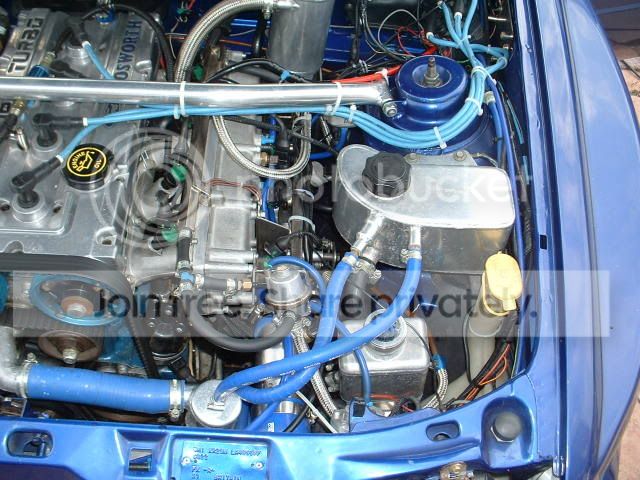
i did alot of playing and testing with my ACT sensors (ecu and a aftermarket gauge) i fitted the them next to each other on the plenum, and both read the same all the time.
i then moved the gauge one into my solid boost pipe between the throotle and intercooler, (insulated by samcos both sides, and heat wrapped) and on Top speed runs they still run the same, But when they was heat soak present, ie Sprints or trackdays there was a huge difference from the actual true ACT.
So they are both now fitted there and i advice for you to do the same
I didn't have to change my map, as it was mapped where No heat soak was present, But i did check the whole map.
You can barely see them fitted, but not clear.
Originally Posted by pondscum
Moving the ACT sensor can require a remap, so definately not an ideal solution to try and get lower numbers.
The temperature correction tables that have been mapped for the ACT calibrated as it is currently in its present location would not be correct for it moved somewhere else which will give a different reading for what is in reality still the same temperature of charge actually entering the head.
With regards to the manifold, they are well proven at far past the flow rate you require for the sort of BHP you are quoting there, but as always with any manifold you can never have too much data so EGT senders in each cylinder would be a cheap bit of worthwhile insurance IMHO.
The temperature correction tables that have been mapped for the ACT calibrated as it is currently in its present location would not be correct for it moved somewhere else which will give a different reading for what is in reality still the same temperature of charge actually entering the head.
With regards to the manifold, they are well proven at far past the flow rate you require for the sort of BHP you are quoting there, but as always with any manifold you can never have too much data so EGT senders in each cylinder would be a cheap bit of worthwhile insurance IMHO.
Not if it was mapped with NO heat soak, ie on the road/run way, where the car was moving cool air thro the intercooler before it was mapp'd each time.
Gear changes have a direct relation to acceleration times to a particular speed.
So those changes would take 1 second off the time taken to accelerate to 150mph or whatever, but they would have FAR less effect on the quarter mile.
While you are changing gear, you acceleration waits for you to finnish (in fact it decreases slightly in most instances) but you are still covering ground on the quarter.
Your logic is completely back to front with regards to wether the car would get to the quarter much quicker and what speed it would be doing, you seem to be implying that you would save a large amount of time off your quarter but would cross the line more slowly?
The reality is that I doubt you would lose even 2 tenths off your quarter time even if those gear changes were reduced to .2 of a second, so certainly not the .7 that some people may be expecting from such a change.
Your terminal speed though, would be effected quite a bit, but not the way you think, it would be INCREASED as you would be now accelerating for a larger amount of time (.5 seconds longer in fact if you believe me on the figures for the quarter time, so around 7mph or so based on the accereration of that car)
So those changes would take 1 second off the time taken to accelerate to 150mph or whatever, but they would have FAR less effect on the quarter mile.
While you are changing gear, you acceleration waits for you to finnish (in fact it decreases slightly in most instances) but you are still covering ground on the quarter.
Your logic is completely back to front with regards to wether the car would get to the quarter much quicker and what speed it would be doing, you seem to be implying that you would save a large amount of time off your quarter but would cross the line more slowly?
The reality is that I doubt you would lose even 2 tenths off your quarter time even if those gear changes were reduced to .2 of a second, so certainly not the .7 that some people may be expecting from such a change.
Your terminal speed though, would be effected quite a bit, but not the way you think, it would be INCREASED as you would be now accelerating for a larger amount of time (.5 seconds longer in fact if you believe me on the figures for the quarter time, so around 7mph or so based on the accereration of that car)
Not if it was mapped with NO heat soak, ie on the road/run way, where the car was moving cool air thro the intercooler before it was mapped each time.
You seem to have slightly missed the point with regards to how temperature calibration tables within an ECU work.
You map at one temperature, then you setup tables to tell the ecu how to vary the fuelling and timing at other temperatures, this setup is based on where you have the temp sender and how the values it gives are calibrated relative to the actual mean average temp of the charge entering the ports in the head.
You also have tables to approximate the amount of heat soak you get into that charge from the ally of the head and inlet based on water temperature of the engine at the time, as this also effects the final intake temp of the charge itself.
You seem to have slightly missed the point with regards to how temperature calibration tables within an ECU work.
You map at one temperature, then you setup tables to tell the ecu how to vary the fuelling and timing at other temperatures, this setup is based on where you have the temp sender and how the values it gives are calibrated relative to the actual mean average temp of the charge entering the ports in the head.
You also have tables to approximate the amount of heat soak you get into that charge from the ally of the head and inlet based on water temperature of the engine at the time, as this also effects the final intake temp of the charge itself.
PassionFord Post Whore!!
Joined: Oct 2003
Posts: 4,775
Likes: 0
From: S/E Kent, Thanet
Just what i was gonna say about gear change speed.
As for instance i've done 4x 11.1 @ 123 - 124 mph, on my dog box.
but i have also done a 11.2 with a complete miss gear, with out it i might of done a 11.0 or better, but it onle lost me 0.1-0.2 seconds due to i was still moveing whist playing silly buggers.
i would guess, if Your car was fitted with my box on that run, i think you would of gained 3mph and 0.2 a second on the quarter.
As for instance i've done 4x 11.1 @ 123 - 124 mph, on my dog box.
but i have also done a 11.2 with a complete miss gear, with out it i might of done a 11.0 or better, but it onle lost me 0.1-0.2 seconds due to i was still moveing whist playing silly buggers.
i would guess, if Your car was fitted with my box on that run, i think you would of gained 3mph and 0.2 a second on the quarter.
PassionFord Post Whore!!
Joined: Oct 2003
Posts: 4,775
Likes: 0
From: S/E Kent, Thanet
Originally Posted by pondscum
Not if it was mapped with NO heat soak, ie on the road/run way, where the car was moving cool air thro the intercooler before it was mapped each time.
You seem to have slightly missed the point with regards to how temperature calibration tables within an ECU work.
You map at one temperature, then you setup tables to tell the ecu how to vary the fuelling and timing at other temperatures, this setup is based on where you have the temp sender and how the values it gives are calibrated relative to the actual mean average temp of the charge entering the ports in the head.
You also have tables to approximate the amount of heat soak you get into that charge from the ally of the head and inlet based on water temperature of the engine at the time, as this also effects the final intake temp of the charge itself.
You seem to have slightly missed the point with regards to how temperature calibration tables within an ECU work.
You map at one temperature, then you setup tables to tell the ecu how to vary the fuelling and timing at other temperatures, this setup is based on where you have the temp sender and how the values it gives are calibrated relative to the actual mean average temp of the charge entering the ports in the head.
You also have tables to approximate the amount of heat soak you get into that charge from the ally of the head and inlet based on water temperature of the engine at the time, as this also effects the final intake temp of the charge itself.
No i havent, Your have missed my point,
Edited to say,
on awaiting in the fire up lane to run, My ACT's raise to 60+oC when at the plenum, but were less than 30oc at the boost pipe.
@ the end of each run @ the 1/4 mile point, my plenum temp had gone down to 50oC, but the actual ACT was still only about 30oC.
And due to this mod, i managed the same terminal speeds @ 4 psi less boost.
No i havent, You have missed my point, i know how i mapped my car.
I suspect that there are some default settings within whichever ECU you are using which are doing that bit of the setup already that you havent understood how to change, but have got lucky with not causing you any problems.
They are still there though, wether you know about them or not as without them how would your car respond to changes in charge temp from how you mapped it if you ever choose to drive it on a different temperature day or at a different speed with different intercooling effects?
PassionFord Post Whore!!
Joined: Oct 2003
Posts: 4,775
Likes: 0
From: S/E Kent, Thanet
Originally Posted by pondscum
No i havent, You have missed my point, i know how i mapped my car.
I suspect that there are some default settings within whichever ECU you are using which are doing that bit of the setup already that you havent understood how to change, but have got lucky with not causing you any problems.
They are still there though, wether you know about them or not as without them how would your car respond to changes in charge temp from how you mapped it if you ever choose to drive it on a different temperature day or at a different speed with different intercooling effects?
i know all about my Ecu, and all the setting, coolant, act etc ect trims, as i mapped it from a blank ecu.
Your missing the point that the ACT is not actually as hot as the sensor is reading due to the heat soak, so in turn retarding the ignition as if the ACT is that high, so taking alot of power away, which is un needed.
Who are you?
Im pondy, Im very pleased to meet you Dan
i wasnt lucky, i check everything i do whilst doing it,
Well did you check how many degrees from Det you were and what your AFR was at various charge temperatures to ensure that the temperature calibration that you dont believe exists within your ecu is correct?
what ECU do you use?
Im pondy, Im very pleased to meet you Dan
i wasnt lucky, i check everything i do whilst doing it,
Well did you check how many degrees from Det you were and what your AFR was at various charge temperatures to ensure that the temperature calibration that you dont believe exists within your ecu is correct?
what ECU do you use?
Your missing the point that the ACT is not actually as hot as the sensor is reading due to the heat soak, so in turn retarding the ignition as if the ACT is that high, so taking alot of power away, which is un needed.
That is indeed completely correct, (well other than sometimes the actual temp may be higher than the ACT sees not lower) I havent missed that point at all, thats why moving the sensor to somewhere with a different amount of heat soak to its current position would potentially need a remap of the relevant temperature correction values to ensure it still keeps you the number of degrees from Det you wish to be in all circumstances (or as close as possible)
That is indeed completely correct, (well other than sometimes the actual temp may be higher than the ACT sees not lower) I havent missed that point at all, thats why moving the sensor to somewhere with a different amount of heat soak to its current position would potentially need a remap of the relevant temperature correction values to ensure it still keeps you the number of degrees from Det you wish to be in all circumstances (or as close as possible)
PassionFord Post Whore!!
Joined: Oct 2003
Posts: 4,775
Likes: 0
From: S/E Kent, Thanet
Originally Posted by pondscum
Who are you?
Im pondy, Im very pleased to meet you Dan
i wasnt lucky, i check everything i do whilst doing it,
Well did you check how many degrees from Det you were and what your AFR was at various charge temperatures to ensure that the temperature calibration that you dont believe exists within your ecu is correct?
what ECU do you use?
Im pondy, Im very pleased to meet you Dan
i wasnt lucky, i check everything i do whilst doing it,
Well did you check how many degrees from Det you were and what your AFR was at various charge temperatures to ensure that the temperature calibration that you dont believe exists within your ecu is correct?
what ECU do you use?
i'm using a Sec's S8,
i always advance to det, then retard it 1-2 degrees, matters on fuel its on, ie, if its a crap super unleaded, or Shell.
i do record the ACT, Boost, RPM, Coolant, and Egt's whilst i'm mapping.
i also use the brakes to hold it at set rpms, to get a true load, and figures.
PassionFord Post Whore!!
Joined: Oct 2003
Posts: 4,775
Likes: 0
From: S/E Kent, Thanet
Originally Posted by pondscum
Your missing the point that the ACT is not actually as hot as the sensor is reading due to the heat soak, so in turn retarding the ignition as if the ACT is that high, so taking alot of power away, which is un needed.
That is indeed completely correct, (well other than sometimes the actual temp may be higher than the ACT sees not lower) I havent missed that point at all, thats why moving the sensor to somewhere with a different amount of heat soak to its current position would potentially need a remap of the relevant temperature correction values to ensure it still keeps you the number of degrees from Det you wish to be in all circumstances (or as close as possible)
That is indeed completely correct, (well other than sometimes the actual temp may be higher than the ACT sees not lower) I havent missed that point at all, thats why moving the sensor to somewhere with a different amount of heat soak to its current position would potentially need a remap of the relevant temperature correction values to ensure it still keeps you the number of degrees from Det you wish to be in all circumstances (or as close as possible)
i do agree with this, as i said in my 1st reply to you.
Im not famliar with the S8 and how it compensates for temperature changes it sees at the ACT sensor, but i would wager that if you have mapped it correctly to work with a sensor in one place, that moving the sensor to somewhere else where it reads differently for the same intake charge will require changes to at least some of the map.
i do agree with this, as i said in my 1st reply to you.
Maybe im just misunderstanding you with regards to the point you are trying to make. Aplogies for that.
I think possibly we both understand engines better than we understand each other in this instance.
Maybe im just misunderstanding you with regards to the point you are trying to make. Aplogies for that.
I think possibly we both understand engines better than we understand each other in this instance.
Thread Starter
I've found that life I needed.. It's HERE!!
Joined: May 2003
Posts: 1,317
Likes: 2
From: Sidcup
Originally Posted by pondscum
Your logic is completely back to front with regards to wether the car would get to the quarter much quicker and what speed it would be doing, you seem to be implying that you would save a large amount of time off your quarter but would cross the line more slowly?
As a result of crossing the line at a faster speed, the quarter mile time is going to be quicker...
PassionFord Post Whore!!
Joined: Oct 2003
Posts: 4,775
Likes: 0
From: S/E Kent, Thanet
my sensors read the same, if in the plenum or if in the boost pipe as long as there is no heat soak present.
Dan, Renten, what act's were you seeing at the start and end of your runs?
Dan, Renten, what act's were you seeing at the start and end of your runs?

Not at all, Im saying it would get to 124mph a lot quicker, but that would happen roughly 0.9sec before the finish line so the car would have to be accelerating for longer before it reaches the quarter mile line and therefor be going faster.
As a result of crossing the line at a faster speed, the quarter mile time is going to be quicker...
It wouldnt happen .9 seconds before the line (based on a zero speed for gear change as you are doing)
You would get to 124 in .9 seconds less time.
The difference in distance taken though would .45 seconds multiplied by the speed of the first gear change and .45 seconds multiplied by the speed of the second gearchange.
So if the average gearchange MPH for those two was say 60mph, you would get to 124mph now .4 seconds or so before the finnish line as the distance would only take you that long to crossed based on speeds of 124mph+

As said a CO2 extinghuiser for 1/4 would be a good idea if thats the only time the problem comes about.
I was surprised that you had high ACT temps at Donnington i never saw mine above 22 deg while on track, i know i will be running alot less boost but. Can you weld two coolers together and see if that makes any difference?
I was surprised that you had high ACT temps at Donnington i never saw mine above 22 deg while on track, i know i will be running alot less boost but. Can you weld two coolers together and see if that makes any difference?
PassionFord Post Whore!!
Joined: Oct 2003
Posts: 4,775
Likes: 0
From: S/E Kent, Thanet
Originally Posted by Renton
Originally Posted by Fiecos Dan
Renten, what act's were you seeing at the start and end of your runs?
That most prob be when you was cueing up, or on the start line. or was that at the end of the run?