


Minimum cossie head thickness????


PassionFords Creator
iTrader: (12)
Joined: May 2003
Posts: 28,824
Likes: 95
From: Blackpool, UK Destination: Rev limiter

frog,
So from the above, a dished piston is better than one that has four little pockets (from a combustion point of view), cos the one with the four pockets would appear "domed" rather than "bowled" ?
So from the above, a dished piston is better than one that has four little pockets (from a combustion point of view), cos the one with the four pockets would appear "domed" rather than "bowled" ?
The pockets are a necessity for valve head clearance during maximum lift with some cams such as BD15s etc.
What i am saying, is that if you require a removal of say, 5cc from the piston crown to get the CR you want, instead of literally skimming 30thou of the tops of the pistons, you should have a machine shop machine the tops everywhere so as to retain the original bowl shape and as much of the original height as possible, and thus maintain your original squish clearance. That help?
And yes, one day we will run out of heads


0-60 in 17 seconds (eek)
Joined: Apr 2004
Posts: 6,717
Likes: 0
From: Berkshire
Originally Posted by brad
frog if your running wild cams you would need valve pockets tho wouldnt you 
oops too slow
oops too slow
 but doesn't that tend to make the piston look more domed overall ? Thus creating the pockets stu was on about ?

Stu,
i had my head work done by a bloke called Adrian.
has a head shop called 'Impulse Developments' in Todmorden.
he was talking about this a while back and i believe he may have experience in this.
thats whty i mentioned it.
Dave.
i had my head work done by a bloke called Adrian.
has a head shop called 'Impulse Developments' in Todmorden.
he was talking about this a while back and i believe he may have experience in this.
thats whty i mentioned it.
Dave.
PassionFords Creator
iTrader: (12)
Joined: May 2003
Posts: 28,824
Likes: 95
From: Blackpool, UK Destination: Rev limiter
You can see the piston shape here if it helps you to imagine how the outer edge is raised to effectively "Funnel" the mixture to teh middle as it reaches TDC.

If your pistons end up down the bore when sat at TDC, the tops have had a lot removed from them. A Std squish has teh piston 20thou above deck height.
*
Edited to say, thats a crap picture actually, too much glare
If your pistons end up down the bore when sat at TDC, the tops have had a lot removed from them. A Std squish has teh piston 20thou above deck height.
*
Edited to say, thats a crap picture actually, too much glare
0-60 in 17 seconds (eek)
Joined: Apr 2004
Posts: 6,717
Likes: 0
From: Berkshire
It's pretty clear on that picture stu, but the pockets look quite small. I am sure I have seen pistons with pockets so deep they almost looked like the piston had a domed overall shape.
Anyway that's not really important - I am not too sure why I am labouring the point
Anyway that's not really important - I am not too sure why I am labouring the point

PassionFord Post Troll
Joined: Apr 2004
Posts: 3,174
Likes: 0
From: West Sussex
so basicly , the edges of the piston ideally should be kept as close to standard height as poss and the bowl machined down as evenly as poss across the width of the original bowl or am i gettin confuddled ?
or am i gettin confuddled ?
PassionFords Creator
iTrader: (12)
Joined: May 2003
Posts: 28,824
Likes: 95
From: Blackpool, UK Destination: Rev limiter
Heres a better pic of the piston shape and squish area...

And a lone piston being weighed and logged.

These should give you an idea how squish works, purely by their shape, now you are thinking about why they are shaped as they are
And a lone piston being weighed and logged.
These should give you an idea how squish works, purely by their shape, now you are thinking about why they are shaped as they are

PassionFords Creator
iTrader: (12)
Joined: May 2003
Posts: 28,824
Likes: 95
From: Blackpool, UK Destination: Rev limiter
Originally Posted by brad
so basicly , the edges of the piston ideally should be kept as close to standard height as poss and the bowl machined down as evenly as poss across the width of the original bowl or am i gettin confuddled ?
or am i gettin confuddled ? )
)
0-60 in 17 seconds (eek)
Joined: Apr 2004
Posts: 6,717
Likes: 0
From: Berkshire
Stu, just thinking about it all again, I am not sure we talk about the same thing when we talk about decompression plates...
If I understand correctly, when the head is skimmed, it looses a given amount of metal, and the overall depth of the "combustion area" in the head reduces. A decompression plate as I understand it, would recover this depth loss.
Is that what you were on about too ? Cos I can understand how it affects the squish area, but it only brings it back to where it was before the skim
If I understand correctly, when the head is skimmed, it looses a given amount of metal, and the overall depth of the "combustion area" in the head reduces. A decompression plate as I understand it, would recover this depth loss.
Is that what you were on about too ? Cos I can understand how it affects the squish area, but it only brings it back to where it was before the skim
PassionFord Post Troll
Joined: Apr 2004
Posts: 3,174
Likes: 0
From: West Sussex
so the chamferd (sp?) edge on the piston bowl keeps the explosion away from the block/head walls and directly underneath the valves in an evenly spaced area helping to avoid hotspots in the squeeze area .

Norris Motorsport
Joined: May 2003
Posts: 3,437
Likes: 3
From: Derbyshire
Before everyone discards their over skimmed heads, I can fully weld the entire head face and remachine the entire face, water ways and chambers to restore the head to as new!!!! It is'nt cheap but it does give new life to an otherwise scrap head!
I can of course recess valves and tip the valve stems for those heads that are around the 138.5mm area, but anything much below that needs the above welding work!
I can of course recess valves and tip the valve stems for those heads that are around the 138.5mm area, but anything much below that needs the above welding work!


Too many posts.. I need a life!!


Joined: May 2004
Posts: 788
Likes: 4
From: shropshire
Originally Posted by Karl
Before everyone discards their over skimmed heads, I can fully weld the entire head face and remachine the entire face, water ways and chambers to restore the head to as new!!!! It is'nt cheap but it does give new life to an otherwise scrap head!
I can of course recess valves and tip the valve stems for those heads that are around the 138.5mm area, but anything much below that needs the above welding work!
I can of course recess valves and tip the valve stems for those heads that are around the 138.5mm area, but anything much below that needs the above welding work!

dont want t sound thick but im interested in how you measeure the head
i mean where would you measure the depth from
would it be from the back of the head from centre of the top to the mating surface of the bottom
obviously digital vernier to do this
as im getting worried now that my head may be scrap and getting the engine built soon
i mean where would you measure the depth from
would it be from the back of the head from centre of the top to the mating surface of the bottom
obviously digital vernier to do this
as im getting worried now that my head may be scrap and getting the engine built soon
PassionFord Post Troll
Joined: Apr 2004
Posts: 3,174
Likes: 0
From: West Sussex
i think it is measured from top face (cam side) to bottom face . has to be measured in a few places to make sure its the same thickness all over
Karl , what does it cost to get the meat put back on the head ? are there any downsides to having it done ?
Karl , what does it cost to get the meat put back on the head ? are there any downsides to having it done ?
Norris Motorsport
Joined: May 2003
Posts: 3,437
Likes: 3
From: Derbyshire
PJ,
The method I use involves stress relieving the head during the welding process as well as having the head pre heated(I don't want to say what I do as thats giving the game away) but it results in a very hard head face and is totally reliable.
The method I use involves stress relieving the head during the welding process as well as having the head pre heated(I don't want to say what I do as thats giving the game away) but it results in a very hard head face and is totally reliable.
PassionFords Creator
iTrader: (12)
Joined: May 2003
Posts: 28,824
Likes: 95
From: Blackpool, UK Destination: Rev limiter
Originally Posted by frog
Stu, just thinking about it all again, I am not sure we talk about the same thing when we talk about decompression plates...
If I understand correctly, when the head is skimmed, it looses a given amount of metal, and the overall depth of the "combustion area" in the head reduces. A decompression plate as I understand it, would recover this depth loss.
If I understand correctly, when the head is skimmed, it looses a given amount of metal, and the overall depth of the "combustion area" in the head reduces. A decompression plate as I understand it, would recover this depth loss.
0-60 in 17 seconds (eek)
Joined: Apr 2004
Posts: 6,717
Likes: 0
From: Berkshire
Originally Posted by Stu @ M Developments
Whilst the decompression plate will restore lost compression, it will by its very nature still increase the squish clearance by raising the cylinder head itself to a higher plane and as such is undesireable.
If say, 0.5 mm had been removed from the head, and the decompression plate was that same thickness, would it affect the squish area as you suggest ?
PassionFords Creator
iTrader: (12)
Joined: May 2003
Posts: 28,824
Likes: 95
From: Blackpool, UK Destination: Rev limiter
Originally Posted by frog
Originally Posted by Stu @ M Developments
Whilst the decompression plate will restore lost compression, it will by its very nature still increase the squish clearance by raising the cylinder head itself to a higher plane and as such is undesireable.
If say, 0.5 mm had been removed from the head, and the decompression plate was that same thickness, would it affect the squish area as you suggest ?

The diagram above may help to show how a spacer plate will move the heads squish area upwards away from teh pistons, thus increasing the squish clearance.
Does that help?

............
Joined: Jun 2003
Posts: 12,970
Likes: 103
From: West Mids
Best thread on here for ages. I'v often wondered about skimming and it's effects. Never knew about squish. Top work to Stu and Karl and everyone who asked good questions. This is what makes the site brilliant for me
0-60 in 17 seconds (eek)
Joined: Apr 2004
Posts: 6,717
Likes: 0
From: Berkshire
mmmm, not sure I do get it....
Would that be because the head isn't actually flat in that area, again, helping to concentrate the fuel mixture as close to the plug tip as possible ? A decompression plate would raise the head, but in a straight up direction, therefore not reproducing the slope in the head's combustion area ?
Would that be because the head isn't actually flat in that area, again, helping to concentrate the fuel mixture as close to the plug tip as possible ? A decompression plate would raise the head, but in a straight up direction, therefore not reproducing the slope in the head's combustion area ?

PassionFord Post Whore!!

Joined: May 2003
Posts: 9,608
Likes: 45
From: Bristol
Originally Posted by Stu @ M Developments
Originally Posted by frog
Originally Posted by Stu @ M Developments
Whilst the decompression plate will restore lost compression, it will by its very nature still increase the squish clearance by raising the cylinder head itself to a higher plane and as such is undesireable.
If say, 0.5 mm had been removed from the head, and the decompression plate was that same thickness, would it affect the squish area as you suggest ?

The diagram above may help to show how a spacer plate will move the heads squish area upwards away from the pistons, thus increasing the squish clearance.
Does that help?
So are the cylinder holes completely round in these plates? I am guessing so, then I understand the problem.
If they had the same shape as the head, would that make it all OK?


PassionFord Post Whore!!
Joined: May 2003
Posts: 3,795
Likes: 0
From: Wiltshire UK
Just as an 'interesting' aside...
I used to do a bit with Talbot Avengers and Sunbeams - the 1.6 pushrod engine has half the combustion chamber in the cylinder.. the piston stops well short of the block deck, absolutely no squish area whatsoever! They can make fair power (in their day anyway) but the ignition advance curve to achieve it is wild - ours had max advance of 48 degrees!
I used to do a bit with Talbot Avengers and Sunbeams - the 1.6 pushrod engine has half the combustion chamber in the cylinder..
the piston stops well short of the block deck, absolutely no squish area whatsoever! They can make fair power (in their day anyway) but the ignition advance curve to achieve it is wild - ours had max advance of 48 degrees!
Norris Motorsport
Joined: May 2003
Posts: 3,437
Likes: 3
From: Derbyshire
Indeed Rich, in essence the more efficient a combustion chamber design the lower the required ignition for MBT conditions. (MBT = minimum spark advance for best torque). This ultimately comes about by two main factors, these being spark plug location in the chamber and the chamber design and size.
Strangely though the effect on potential bhp has little to do with chamber design. It's all about efficiency for fuel economy and emissions these days!
Strangely though the effect on potential bhp has little to do with chamber design. It's all about efficiency for fuel economy and emissions these days!

I've found that life I needed.. It's HERE!!
Joined: May 2003
Posts: 1,144
Likes: 9
Originally Posted by frog
mmmm, not sure I do get it....
Would that be because the head isn't actually flat in that area, again, helping to concentrate the fuel mixture as close to the plug tip as possible ? A decompression plate would raise the head, but in a straight up direction, therefore not reproducing the slope in the head's combustion area ?
Would that be because the head isn't actually flat in that area, again, helping to concentrate the fuel mixture as close to the plug tip as possible ? A decompression plate would raise the head, but in a straight up direction, therefore not reproducing the slope in the head's combustion area ?

Adding a decomp plate now makes them further apart, so not "squishing" the mixture as much as it should do:

**this is my understanding of what has been said in this post**

Too many posts.. I need a life!!
Joined: Jul 2003
Posts: 852
Likes: 0
Originally Posted by Karl
PJ,
The method I use involves stress relieving the head during the welding process as well as having the head pre heated(I don't want to say what I do as thats giving the game away) but it results in a very hard head face and is totally reliable.
The method I use involves stress relieving the head during the welding process as well as having the head pre heated(I don't want to say what I do as thats giving the game away) but it results in a very hard head face and is totally reliable.
after mapping, must admit andy fisher was a bit sceptical about this head repairing process cheers steve
0-60 in 17 seconds (eek)
Joined: Apr 2004
Posts: 6,717
Likes: 0
From: Berkshire
Here's how I understand it...
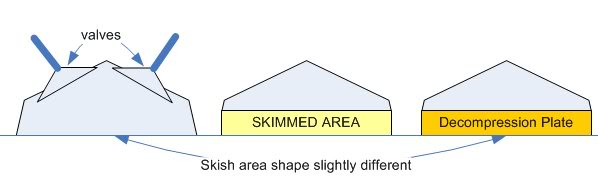
In the picture above, the decomp. plate only replaces the same amount of material that was removed by the skim(s).
However, because the walls of the plate are vertical, the squish area has changed shape.
Over to you stu...
In the picture above, the decomp. plate only replaces the same amount of material that was removed by the skim(s).
However, because the walls of the plate are vertical, the squish area has changed shape.
Over to you stu...

PassionFord Post Whore!!
Joined: May 2003
Posts: 3,795
Likes: 0
From: Wiltshire UK
Originally Posted by frog
Here's how I understand it...
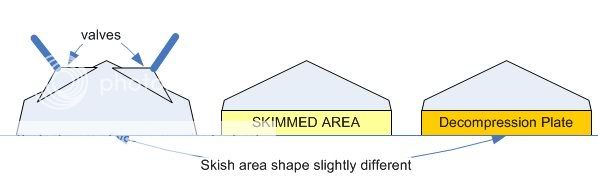
In the picture above, the decomp. plate only replaces the same amount of material that was removed by the skim(s).
However, because the walls of the plate are vertical, the squish area has changed shape.
Over to you Stu...
In the picture above, the decomp. plate only replaces the same amount of material that was removed by the skim(s).
However, because the walls of the plate are vertical, the squish area has changed shape.
Over to you Stu...
PassionFord Post Troll
Joined: Apr 2004
Posts: 3,174
Likes: 0
From: West Sussex
when we talk about skimming a head , we are only talking about .0000eleventy millionth of a gnats cock , surely a thin flimsy bit of metal cant be a good idea aswell as a head gasket

PassionFord Post Whore!!
Joined: Aug 2004
Posts: 4,364
Likes: 0
From: Kent
With YB's people worry too much
Look at it this way...a STD 4x4 or 2wd YB can take 400bhp no bothers...a 4x4 can take 500bhp no bothers...who gives a fook about height of head..especially in a sub 400 engine!!!
Look at it this way...a STD 4x4 or 2wd YB can take 400bhp no bothers...a 4x4 can take 500bhp no bothers...who gives a fook about height of head..especially in a sub 400 engine!!!
PassionFord Post Whore!!
Joined: May 2003
Posts: 3,795
Likes: 0
From: Wiltshire UK
Originally Posted by ImaRacing 700
With YB's people worry too much
Look at it this way...a STD 4x4 or 2wd YB can take 400bhp no bothers...a 4x4 can take 500bhp no bothers...who gives a fook about height of head..especially in a sub 400 engine!!!
Look at it this way...a STD 4x4 or 2wd YB can take 400bhp no bothers...a 4x4 can take 500bhp no bothers...who gives a fook about height of head..especially in a sub 400 engine!!!