


Injector Duration


Thread Starter
Yoon
Joined: Oct 2005
Posts: 6,844
Likes: 0
From: Norwich
 Injector Duration
Right then,after reading Stu's article in FF this month I got looking into injector duration.
Am I along the right path in thinking that injectors can only on between 0 and 233 milisecs?
Therefor it you can't leave one on for ages like a tap?
So a bigger injector will give more fuel at the same pulse width becuase of the small working range?
Got Hillier's book two on Engine management and loadsa similar stuff and it doesn't seem to be clear to me.
Am I along the right path in thinking that injectors can only on between 0 and 233 milisecs?
Therefor it you can't leave one on for ages like a tap?
So a bigger injector will give more fuel at the same pulse width becuase of the small working range?
Got Hillier's book two on Engine management and loadsa similar stuff and it doesn't seem to be clear to me.

Thread Starter
Yoon
Joined: Oct 2005
Posts: 6,844
Likes: 0
From: Norwich
http://www.injector.com/faq.php#faq2
That kinda answers it about the duty cycle and the 233 thing I was about is shit.
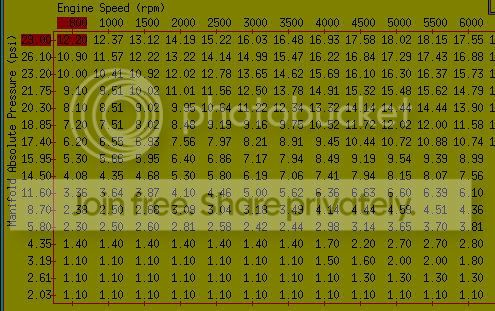
So does in the piccy at the top of page 116,are those numbers in the map the milisecs the injectors are open for?
That kinda answers it about the duty cycle and the 233 thing I was about is shit.
So does in the piccy at the top of page 116,are those numbers in the map the milisecs the injectors are open for?

Professional Waffler

Joined: May 2003
Posts: 30,980
Likes: 9
From: barry-south wales
i havent seen the mag  do a scan and ill tell you what the scale is
some calibration programs use milliseconds and some just use a hex number
it doesnt really matter what the unit it,,, aslong as it can be increased
do a scan and ill tell you what the scale is some calibration programs use milliseconds and some just use a hex number
it doesnt really matter what the unit it,,, aslong as it can be increased
Professional Waffler
Joined: May 2003
Posts: 30,980
Likes: 9
From: barry-south wales
where have you got 0-233 from? its probable 0-255 which is 11111111 in binary, so suitable for an 8 bit processor
there would be a direct relation between the raw data number and the milli second output
there would be a direct relation between the raw data number and the milli second output
Trending Topics
 as it would be 563 in decimal
Professional Waffler
Joined: May 2003
Posts: 30,980
Likes: 9
From: barry-south wales
sorry all ive wrote can be a ltitle confusing!
remember the time the injector is open is also related to revs! as the engine spins faster, the injector/ecu has less time to inject the correct amount of fuel
remember the time the injector is open is also related to revs! as the engine spins faster, the injector/ecu has less time to inject the correct amount of fuel


Professional Waffler
Joined: May 2003
Posts: 30,980
Likes: 9
From: barry-south wales
hang on,,,, you firstly you would never run an injector flat out,,,
you may want to run it up to a duty cycle (the ratio between its On time and its Off time) 80%
dont worry about the units used it the mapping calibration program!
if you had a small injector (say a standard yellow cosworth) and switched it for 5 milliseconds and you had a gray injector and swtiched it for 5 milliseconds, which injector would pass the most amount of fuel? the gray of cause, so the pulse width of the injector havent changed, but the flow rate has! more fuel
you may want to run it up to a duty cycle (the ratio between its On time and its Off time) 80%
dont worry about the units used it the mapping calibration program!
if you had a small injector (say a standard yellow cosworth) and switched it for 5 milliseconds and you had a gray injector and swtiched it for 5 milliseconds, which injector would pass the most amount of fuel?
the gray of cause, so the pulse width of the injector havent changed, but the flow rate has! more fuel



PassionFord Regular
Joined: May 2004
Posts: 466
Likes: 1
From: south wales
Originally Posted by GARETH T
where have you got 0-233 from? its probable 0-255 which is 11111111 in binary, so suitable for an 8 bit processor
there would be a direct relation between the raw data number and the milli second output
there would be a direct relation between the raw data number and the milli second output
Regards Dave R.



The injector duration is essentially the result of an equation, the value you are quoting is just one element of that.
Typically you will have:
offset which is an adder
scaler which is a multiplier
then loads of other factors such as temperature corrects etc
So from the base table, you look up your 200, you then mutliply it by a scaling factor to convert it to millisecond, then you add in a number of milliseconds offset
(then all the temp correction etc comes in after and alters it again)
To convert this into a % duty cycle, you basically need to then divide it by the amount of time that 1 rpm takes at that point in the map.
Typically you will have:
offset which is an adder
scaler which is a multiplier
then loads of other factors such as temperature corrects etc
So from the base table, you look up your 200, you then mutliply it by a scaling factor to convert it to millisecond, then you add in a number of milliseconds offset
(then all the temp correction etc comes in after and alters it again)
To convert this into a % duty cycle, you basically need to then divide it by the amount of time that 1 rpm takes at that point in the map.
Professional Waffler
Joined: May 2003
Posts: 30,980
Likes: 9
From: barry-south wales
Originally Posted by Chip-3Door
To convert this into a % duty cycle, you basically need to then divide it by the amount of time that 1 rpm takes at that point in the map.
Originally Posted by GARETH T
Originally Posted by Chip-3Door
To convert this into a % duty cycle, you basically need to then divide it by the amount of time that 1 rpm takes at that point in the map.
If its sequential injection yeah



Too many posts.. I need a life!!
Joined: Aug 2006
Posts: 818
Likes: 1
From: Lisbon

Thread
Thread Starter
Forum
Replies
Last Post
mk3ste
Restorations, Rebuilds & Projects.
19
Oct 17, 2021 10:09 AM
DixieTheKid
Ford Sierra/Sapphire/RS500 Cosworth
11
Jun 6, 2020 11:20 AM