


Cossie alternator voltage

Thread Starter
Joined: Jul 2006
Posts: 62,772
Likes: 1,050
From: Darlington county durham
 Cossie alternator voltage
Can you do me a favor people and check your alternator voltage.
Im thinking my alternator might be nackered.
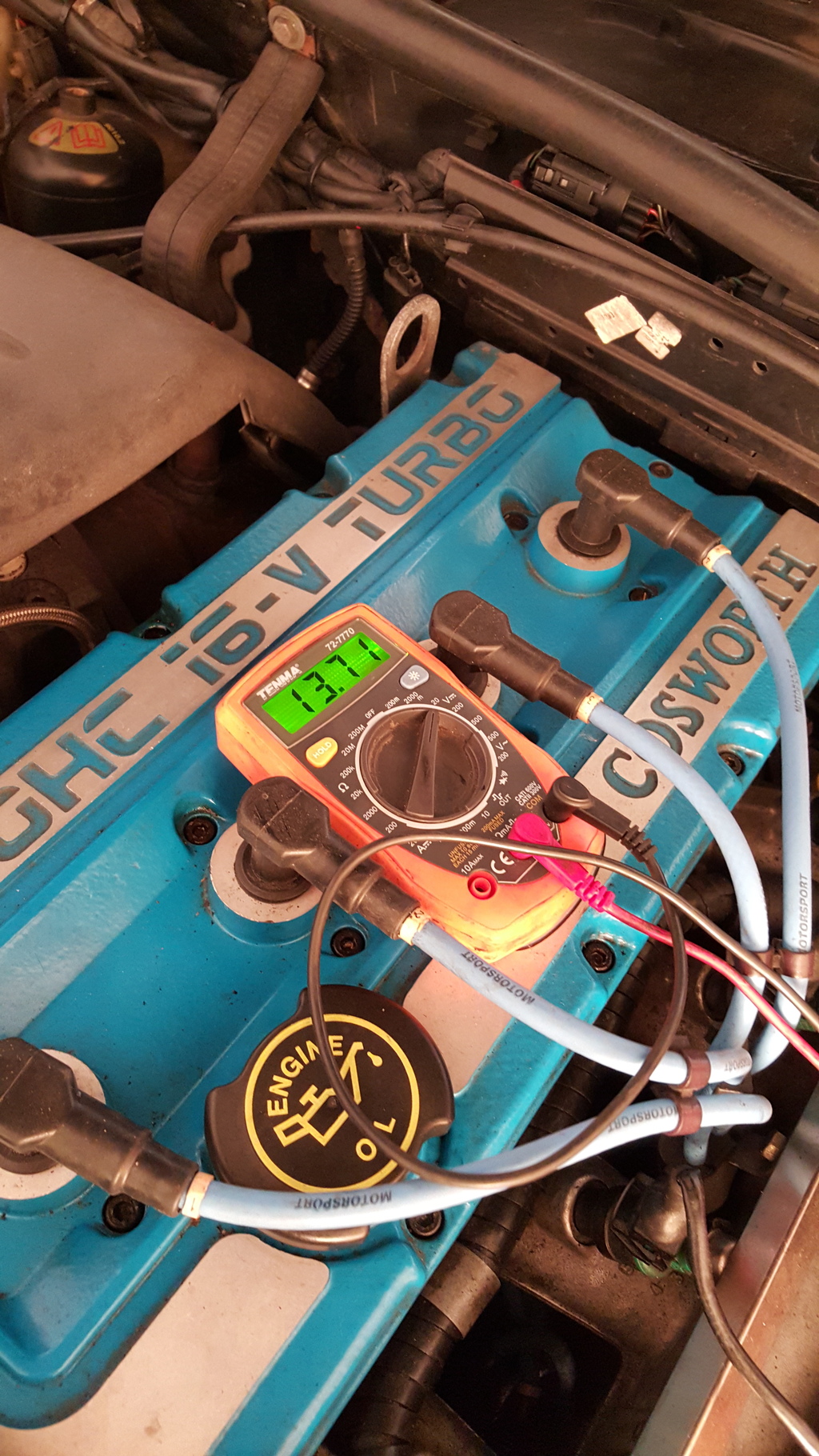
Its only 13.71 volts and when im revving the engine the voltage just stays the same.
I dont know if its just a cossie thing lol cause most cars the voltage should be higher or less its just me worrying.
Im thinking my alternator might be nackered.

Its only 13.71 volts and when im revving the engine the voltage just stays the same.
I dont know if its just a cossie thing lol cause most cars the voltage should be higher or less its just me worrying.




Did you take that picture with a phone?
PS, some older Bosch alternators charge at 13.8v modern alternators are almost always 14.4-14.6 volts.
Normally a bad diode would mean a flat battery if left to stand.
Rob,
PS, some older Bosch alternators charge at 13.8v modern alternators are almost always 14.4-14.6 volts.
Normally a bad diode would mean a flat battery if left to stand.
Rob,
Trending Topics
Agreed with the above. Also the regulator will have some level of temperature compensation, at cold you might find you charge at over 14v, with hot engine bay it will be lower.
Thread Starter
Joined: Jul 2006
Posts: 62,772
Likes: 1,050
From: Darlington county durham
Thread Starter
Joined: Jul 2006
Posts: 62,772
Likes: 1,050
From: Darlington county durham
The reason im thinking its the alternator is cause the battery light is on ever so slighty and when im coming to a junction the light gets brighter.

cossie fan (unluckerly)


Joined: Nov 2009
Posts: 9,798
Likes: 435
From: hampshire
I've a brand new ford one to go on mine as my warning light was dimly on last few times I drove it. But when I removed my engine I found the main wire to the alternator had been rubbing on something and is corroded to fuck
Thread Starter
Joined: Jul 2006
Posts: 62,772
Likes: 1,050
From: Darlington county durham
I was thinking about putting a wire from the alternator to the battery to see if this helps and doing this will eliminate the orginal wiring.
Ive checked the resistance in the positve wire from the battery to the alternator and that seems fine.
Ive checked the resistance in the positve wire from the battery to the alternator and that seems fine.
Thread Starter
Joined: Jul 2006
Posts: 62,772
Likes: 1,050
From: Darlington county durham
I put a new earth lead from the battery to the battery tray on Saturday and this hasnt helped.
I will check that wire tomorrow when i have another look at it.
I will check that wire tomorrow when i have another look at it.



PassionFord Post Troll
Joined: Feb 2014
Posts: 3,120
Likes: 316
From: Scotland
I've got the same problem Glenn my battery light is on when I start up and it loses its charge rapidly on a brand new battery. When getting my alarm fitted the installer did say the alternator wasn't boosting voltage much when revving so I'm gonna buy a new one and drop down bracket.

If it was me would change the voltage regulator, maybe a cheap fix.
With the regulator when the brushes wear away you will still show 13.5+v but its the amps that will drop causing issues of battery light ect.
With the regulator when the brushes wear away you will still show 13.5+v but its the amps that will drop causing issues of battery light ect.





Gary Krishna
iTrader: (9)
Joined: Mar 2008
Posts: 4,029
Likes: 67
From: Rickmansworth, Hertfordshire.
Try doing a volt drop check on the alternator cable mate as this can have an effect if there is high resistance on the cable.
With the engine running switch on lights, heater, heated rear screen etc, now with your multimeter set to volts, put one probe on the positive terminal of the the battery and the other on the main cable connection on the back of the alternator and see what you get. You shouldn't have any more than .5v reading. More than that suggests your cable isn't as good as it should be and you need to replace/rewire it
I checked mine a little while ago and was getting 14.3v at the battery.
With the engine running switch on lights, heater, heated rear screen etc, now with your multimeter set to volts, put one probe on the positive terminal of the the battery and the other on the main cable connection on the back of the alternator and see what you get. You shouldn't have any more than .5v reading. More than that suggests your cable isn't as good as it should be and you need to replace/rewire it
I checked mine a little while ago and was getting 14.3v at the battery.

PassionFord Post Whore!!

Joined: May 2013
Posts: 4,587
Likes: 403
From: Holbury,Southampton
Hi Glenn, it sounds like your alternator is on the way out as on mine a while back I noticed the red light didnt go out completely and was flickering on/off when going slow. The battery was not holding its charge either. I jump started it one day before taking it out and after a couple of miles noticed the indicators were not working and then shortly after it died on me. The battery was as flat as a pancake so I had to call out the RAC. When he came he checked the battery which was knackered and also checked the alternator which was knackered as well! He put a new battery in just so I could get home and I have now fitted a new alternator and battery and everything is back to normal. After 25 years and 105,000 miles I guess the original alternator had had enough. By the way the new alternator is showing 14.5 volts.
Last edited by cossynut2; Oct 29, 2015 at 09:44 AM.
PassionFord Post Whore!!
Joined: May 2013
Posts: 4,587
Likes: 403
From: Holbury,Southampton
Thread Starter
Joined: Jul 2006
Posts: 62,772
Likes: 1,050
From: Darlington county durham
The spare one i have is a 90Amp one. When im slowing down or indicating the battery light will flicker on.
Ive got a new regulator coming so i will fit this to my spare alternator and fot that to the car. If that one is no good i will just buy a new one.
Ive got a new regulator coming so i will fit this to my spare alternator and fot that to the car. If that one is no good i will just buy a new one.
Last edited by Glenn_; Oct 29, 2015 at 03:06 PM.
PassionFord Post Whore!!
Joined: May 2013
Posts: 4,587
Likes: 403
From: Holbury,Southampton
Sounds like a good plan Glenn.
You can still have 13+v and still not enough to charge the battery.
Think turbo, A T2 and a GT35 at 30psi will have the same pressure but different flow rates.
Cossie alternator voltage
Resistance through your pipework, pressure of the air being forced through it and flow rate is all relative to each other.
2 different turbos with the same pipework, supplying the same quantity of air to the same engine will always produce exactly the same boost pressure.
And likewise, 2 different turbos, running at 20psi with the same pipework and engine, will be feeding the engine with the same quantity of air.
2 different turbos with the same pipework, supplying the same quantity of air to the same engine will always produce exactly the same boost pressure.
And likewise, 2 different turbos, running at 20psi with the same pipework and engine, will be feeding the engine with the same quantity of air.
Last edited by RichieST; Oct 30, 2015 at 10:12 PM.
Resistance through your pipework, pressure of the air being forced through it and flow rate is all relative to each other.
2 different turbos with the same pipework, supplying the same quantity of air to the same engine will always produce exactly the same boost pressure.
And likewise, 2 different turbos, running at 20psi with the same pipework and engine, will be feeding the engine with the same quantity of air.
2 different turbos with the same pipework, supplying the same quantity of air to the same engine will always produce exactly the same boost pressure.
And likewise, 2 different turbos, running at 20psi with the same pipework and engine, will be feeding the engine with the same quantity of air.
30psi through a macdonals straw and 30psi through a drain pipe is still 30psi but is still different,
I was trying to give a example people could relate to. In a but nut shell checking the Voltage of a alternator to see if its knackered is not going to tell you if it is or isnt its only going to tell you one that might be wrong.

That's perfectly normal, modern cars are different.
A common problem is the wiring (like any old wiring) builds resistance, but you say you have measured the resistance anyway. You could measure the output from the alternator itself.
The light issue is quite common, it's because the voltage is greater on one side of the bulb. A high electrical demand can cause this to happen.
Martin
A common problem is the wiring (like any old wiring) builds resistance, but you say you have measured the resistance anyway. You could measure the output from the alternator itself.
The light issue is quite common, it's because the voltage is greater on one side of the bulb. A high electrical demand can cause this to happen.
Martin