


Merkur XR4ti Capri 3000GT Mk1


Thread Starter
MERKUR XR4ti
Joined: Dec 2009
Posts: 133
Likes: 0
From: In The Ford Zone
 Merkur XR4ti Capri 3000GT Mk1
Hi guy's I thought I should say hello as I have just Joind your Old School posse  I have for 25 years been a Capri Owner but also one or two other Old School FORD's too
  . At the moment I have been working on a 1986 Mercury Merkur XR4ti
  If you are unsure it is an AMERICAN Sierra XR4 But with the Ford Mustang and Thunder-bird 2.3 Turbo motor fitted.
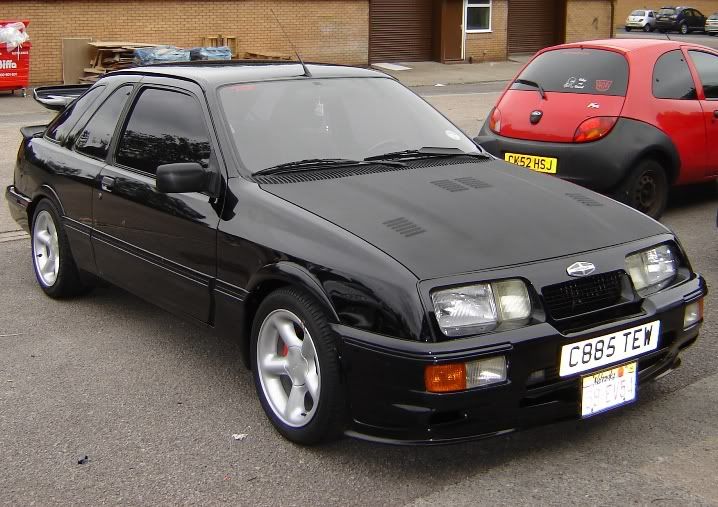
I also Have a 1972 2000 V4 GT Vista Special, But now fitted with a nice 3000 V6 From my other Mk 3000GT wich fell apart about 10 years ago now.


I have for 25 years been a Capri Owner but also one or two other Old School FORD's too . At the moment I have been working on a 1986 Mercury Merkur XR4ti If you are unsure it is an AMERICAN Sierra XR4 But with the Ford Mustang and Thunder-bird 2.3 Turbo motor fitted.I also Have a 1972 2000 V4 GT Vista Special, But now fitted with a nice 3000 V6 From my other Mk 3000GT wich fell apart about 10 years ago now.


Turbocharging Technician
Joined: Jul 2010
Posts: 3,557
Likes: 0
From: Top secret. Mission:Imposible.
very nice and tidy under there! is that mostly how it came out the factory? i know they used to race these about the same time as our bttc cossies, always thought the engines were v6s, obviously not! as the collogne was available in that size.
Thread Starter
MERKUR XR4ti
Joined: Dec 2009
Posts: 133
Likes: 0
From: In The Ford Zone
https://passionford.com/forum/ford-s...ays-hello.html
History
The cars were hand assembled and built entirely by Karmann Coachwerks in Rheine, Germany. Unlike with the Scorpio, the XR4Ti didn't carry over the Sierra badge from Europe
The XR4Ti was distinguished mechanically by its turbocharged Ford Lima 2.3 L 4-cylinder SOHC engine and independent rear suspension, and stylistically by its large bi-plane spoiler (replaced in later years with a single rear spoiler). It came with either the C3 3-speed automatic transmission or the Ford Type 9, 5-speed manual transmission. Mechanically, it differed from the European Ford Sierra XR4i, which had a 2.8l Ford Cologne V6. Airbag legislation for the 1990 model years and weak sales as are frequently cited as the cause for the Merkur range to be discontinued.
The XR4Ti sold for approx. US$18,750.00
The XR4Ti was on Car and Driver's Ten Best list for 1985.
Production Figures
1985-1989
YearUnits198512,400198613,59919877,34219886,283198 92,870Total42,464
The XR4Ti came with one engine, the 2.3 liter turbocharged, in-line, fuel injected 'Lima' four cylinder using an EEC-IV computer. The 4-cylinder engine was generally rated at 145 hp (108 kW) when mated with an automatic transmission (8 to 10 lbf/in² [55 to 70 kPa] boost), and 175 hp (130 kW) when matched with the 5-speed manual transmission (12 to 14 lb (6 kg). boost). This engine is the same as that found in the SVO Mustang and the Thunderbird Turbo Coupe of the time, though the SVO Mustang and Thunderbird Turbo Coupe differed by having an intercooler and different EECIV programming.
The XR4Ti options included heated seats, leather seats, power windows, power door locks and a moonroof (retractable, tinted glass), with heated power mirrors coming equipped as a standard item. Some were sold with crank windows (very few, in actuality) and a solid roof but most came with everything but the leather seats.
In its short life, the XR4Ti saw some minor changes either by design or by implemented TSB. Examples include: uprated heater cores, larger rear hatch glass, improved steering rack, upgraded dash construction etc. Many of these parts were taken from the Sierra Mk.II body shell which was only sold in continental Europe with some being Merkur specific parts. Most of these changes occurred in the 1987 model year.
The top speed of the manual transmission XR4Ti 1985-87 was 140 mph (230 km/h). The bi-plane rear spoiler was changed to a single spoiler for the 1988-1989 cars; it actually increased the drag coefficient compared to the bi-plane spoiler of the earlier cars which have a coefficient of 0.32.
Car & Driver tests for the XR4Ti reported 0-60 mph times from 7 seconds flat and as high 7.9 seconds and 1/4 mile times at around 15.7 seconds. Later tests by Car & Driver showed 7.8 seconds for the 0-60 mph times and they mentioned the press car might have been a ringer which was common at the time. In their test data, they initially stated the car came with a limited slip differential which was a misprint, at the time there were no LSD's available in either the American Merkur XR4Ti or its sister car the Europe-only XR4i. It wasn't until the introduction of the European only XR4x4 and Cosworth Sierra that an LSD was offered from the factory.

A former Trans-Am Merkur XR4Ti which won the GTO class at the 1988 24 Hours of Daytona. The large double rear-wing is evident.
Despite the XR4Ti never being sold outside the United States and Canada, in 1985, Andy Rouse used one to compete in the British Saloon Car Championship. He took the overall title for that year and the class title for the following year with 14 race victories altogether.[3] Eggenberger Motorsport was among the few to use an XR4Ti to compete in the ETCC and the DTM (German Touring Car Championship) with positive results. Ford would use the car's technical feedback from the teams to develop the super car version of the Sierra in 1986, the Sierra Cosworth, shortly superseded by the RS500. Some of the body panels used to stiffen the Sierra chassis and create the Merkur shell were subsequently branded 909 Motorsport parts for later adaptation to a Sierra shell. Many see the successes and failures of the XR4Ti as being the blueprint for success of the dominant Sierra Cosworth.
Between 1986 and 1987, Wally Dallenbach, Jr. and Scott Pruett campaigned the Roush prepped XR4Ti, although of a tubeframe construction like that of a NASCAR racer, to take the Trans-Am Series title.
Trending Topics
Thread Starter
MERKUR XR4ti
Joined: Dec 2009
Posts: 133
Likes: 0
From: In The Ford Zone

Thread
Thread Starter
Forum
Replies
Last Post
wowk
General Car Related Discussion.
4
Mar 30, 2021 07:49 PM
