


Mapping concepts


Thread Starter
Part of the Furniture
Joined: Jul 2006
Posts: 165
Likes: 0
 Mapping concepts
Reading many threads on debating likes of turbo sizes ecu hardware software this then that all means shit to me  For argument sake going to refer to a normally aspirated engine in standard trim. All i understand from reading from here the whole point to mapping is to make more power aight but how? How would you even begin mappng a standard car after u hook up everything like??
For argument sake going to refer to a normally aspirated engine in standard trim. All i understand from reading from here the whole point to mapping is to make more power aight but how? How would you even begin mappng a standard car after u hook up everything like??

Banned
Joined: Dec 2002
Posts: 142
Likes: 1
Re: Mapping concepts
Originally Posted by CJBear
Reading many threads on debating likes of turbo sizes ecu hardware software this then that all means shit to me For argument sake going to refer to a normally aspirated engine in standard trim. All i understand from reading from here the whole point to mapping is to make more power aight but how? How would you even begin mappng a standard car after u hook up everything like??
For argument sake going to refer to a normally aspirated engine in standard trim. All i understand from reading from here the whole point to mapping is to make more power aight but how? How would you even begin mappng a standard car after u hook up everything like??
Thread Starter
Part of the Furniture
Joined: Jul 2006
Posts: 165
Likes: 0
I seen various screen prints of what looks like series of tables and a green mountain next to it? I guess this is where you would change the ignition and fuel figures but what do all the figures means? Fair enough 12:1 is what a non-turbo car should be, but what about everywhere else like normal driving how does that translate?

Yoon
Joined: Oct 2005
Posts: 6,844
Likes: 0
From: Norwich
Banned
Joined: Dec 2002
Posts: 142
Likes: 1
Originally Posted by CJBear
I seen various screen prints of what looks like series of tables and a green mountain next to it? I guess this is where you would change the ignition and fuel figures but what do all the figures means? Fair enough 12:1 is what a non-turbo car should be, but what about everywhere else like normal driving how does that translate?
The best thing you could do is read Stu's live mapping tutorial, but essentially the grid next to the graph is like an excel sheet, up one side is RPM and up the other is either Boost or Throttle position
The values in the grid tell the ECU how much fuel to put in for any set of cricumstances.
So at 6000rpm and 90% throttle, it looks up the values for that, and opens the injector for the amount of time it says in the map.
Get your head round that concept first, and then we can talk some more about other factors that also enter into it that arent clear from that map.
Banned
Joined: Dec 2002
Posts: 142
Likes: 1
Thread Starter
Part of the Furniture
Joined: Jul 2006
Posts: 165
Likes: 0
Originally Posted by chip-3door
Trending Topics
Banned
Joined: Dec 2002
Posts: 142
Likes: 1

CLICK HERE FOR FULL SIZE: http://i7.photobucket.com/albums/y25...icp-rp-005.png
Thats an ignition map.
The ecu looks at sensors on the engine to determine your current RPM and Boost.
It then looks up on that table to find the appropriate value, (if its in between two or 4 cells it takes an average basically)
So at 1 bar of boost (2000mpa) and 5000rpm, it would take the values of 18.25(1751mpa) and 14.25(225amap) and come back with 16.25
So that would be your base timing in degrees
Thread Starter
Part of the Furniture
Joined: Jul 2006
Posts: 165
Likes: 0
Right so how do you get those figures in the tables to start off with? is a base map basically all the tables filled in with default numbers or one which is designed to run a standard car 'out the box'
Banned
Joined: Dec 2002
Posts: 142
Likes: 1
Originally Posted by CJBear
Right so how do you get those figures in the tables to start off with? is a base map basically all the tables filled in with default numbers or one which is designed to run a standard car 'out the box'
When you buy an ECU, its blank.
You either guess at some figures to get it running, or you beg/borrow/steal them from someone else with the same ecu
Thats just to get you "in the right ballpark" you then do the process of "mapping" to refine them to more suitable values for your car than for audi 20vt or whatever you just stole the numbers for!
Thread Starter
Part of the Furniture
Joined: Jul 2006
Posts: 165
Likes: 0
ooo so its a crafty job then
Looking a your picture you got RPM against Map sites (whats map sites?) sticking with non-turbos how would this work? guess you would use RPM against throttle position or from air flow sensor or manifold pressure (map)?
Looking a your picture you got RPM against Map sites (whats map sites?) sticking with non-turbos how would this work? guess you would use RPM against throttle position or from air flow sensor or manifold pressure (map)?
Banned
Joined: Dec 2002
Posts: 142
Likes: 1
Originally Posted by CJBear
ooo so its a crafty job then
Looking a your picture you got RPM against Map sites (whats map sites?) sticking with non-turbos how would this work? guess you would use RPM against throttle position or from air flow sensor or manifold pressure (map)?
Looking a your picture you got RPM against Map sites (whats map sites?) sticking with non-turbos how would this work? guess you would use RPM against throttle position or from air flow sensor or manifold pressure (map)?
Airflow meter being the most common on production cars
Banned
Joined: Dec 2002
Posts: 142
Likes: 1
Originally Posted by CJBear
what sort areas would you look at getting a car to idle?
but most ECU's have seperate idle strategy's as well not on those maps, on the L8 from RP Labs for example you have a curve of required idle speed versus temp, and you have adjustments for timing based on distance from idle etc.
There isnt just a single box that you enter a value in to get the car to idle, its more complicated than that.
Thread Starter
Part of the Furniture
Joined: Jul 2006
Posts: 165
Likes: 0
Just in general really the typical way you would go about setting up a standard engine hopefully if i understand the process and concepts then i might understand these books on tuning, gotto start somewere
Thread Starter
Part of the Furniture
Joined: Jul 2006
Posts: 165
Likes: 0
Originally Posted by chip-3door
Originally Posted by CJBear
what sort areas would you look at getting a car to idle?
but most ECU's have seperate idle strategy's as well not on those maps, on the L8 from RP Labs for example you have a curve of required idle speed versus temp, and you have adjustments for timing based on distance from idle etc.
There isnt just a single box that you enter a value in to get the car to idle, its more complicated than that.
Banned
Joined: Dec 2002
Posts: 142
Likes: 1
Idle valve control tends to be of closed loop operation.
So the further the idle strays from the required value the more the ICV opens to control it.
So if you are somewhere with less pressure (high altitutude) it would automatically compensate for that by being open a bigger percentage of the time.
Ignition as idle speed control is crude but some systems do it.
you basically set an "idle screw" of some sort to allow enough air in to idle on both a cold day or a hot day, and then you set the ignition to control the speed.
The way this works would be something like
500rpm 15 degrees
1000rpm 12 degrees
1500rpm 5 degrees
What this means is that if the revs increase, the ignition is naturally pulled further and further down as the ECU interpolates towards the higher rpm values which are less ignition.
So the further the idle strays from the required value the more the ICV opens to control it.
So if you are somewhere with less pressure (high altitutude) it would automatically compensate for that by being open a bigger percentage of the time.
Ignition as idle speed control is crude but some systems do it.
you basically set an "idle screw" of some sort to allow enough air in to idle on both a cold day or a hot day, and then you set the ignition to control the speed.
The way this works would be something like
500rpm 15 degrees
1000rpm 12 degrees
1500rpm 5 degrees
What this means is that if the revs increase, the ignition is naturally pulled further and further down as the ECU interpolates towards the higher rpm values which are less ignition.

PassionFords Creator
iTrader: (12)
Joined: May 2003
Posts: 28,824
Likes: 95
From: Blackpool, UK Destination: Rev limiter
Originally Posted by CJBear
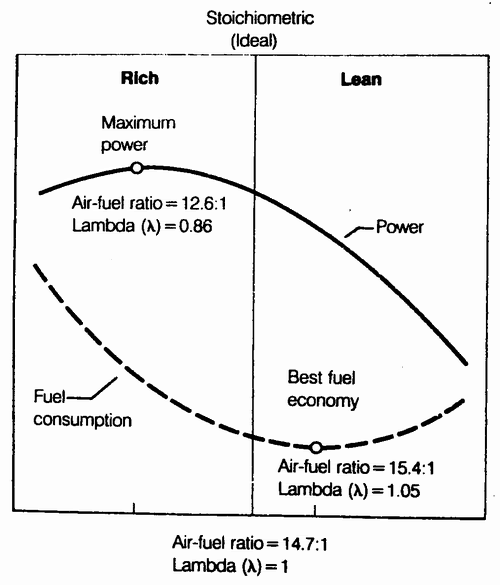
So if AFR not constant for all revs and load sites how do you know how rich or lean to make it?
There are various rules to learn in any trade, AFR being one of them in a tuners.
Excuse my answwer if you actually meant "What AFR do you need for all the different loads" as oposed to what you actualy asked...

Banned
Joined: Dec 2002
Posts: 142
Likes: 1
POTENTIALLY WRONG RULE OF THUMB:
On boost hard = 11.5:1
On boost a little = 12:1
Part throttle economy 15:1
Thats a total ballpark to aim for, but can vary from engine to engine, and you need to do things such as monitor EGT to know whats happening.
On boost hard = 11.5:1
On boost a little = 12:1
Part throttle economy 15:1
Thats a total ballpark to aim for, but can vary from engine to engine, and you need to do things such as monitor EGT to know whats happening.


Professional Waffler

Joined: May 2003
Posts: 30,980
Likes: 9
From: barry-south wales
Originally Posted by foreigneRS
you need to buy dave walkers book and read it 
 ) it will give you an understanding of what and how ecu's work
 http://www.amazon.co.uk/Engine-Manag...e=UTF8&s=books
Thread Starter
Part of the Furniture
Joined: Jul 2006
Posts: 165
Likes: 0
Originally Posted by foreigneRS
you need to buy dave walkers book and read it
the books aimed i felt at people with some basic knowledge and concepts in some sort of order me aint got a banana 
Professional Waffler
Joined: May 2003
Posts: 30,980
Likes: 9
From: barry-south wales
Originally Posted by chip-3door
As you are in london its a shame you werent at the middlesex RSOC meet last month, there was some properly in depth mapping chat going on 
Thread Starter
Part of the Furniture
Joined: Jul 2006
Posts: 165
Likes: 0
Originally Posted by chip-3door
As you are in london its a shame you werent at the middlesex RSOC meet last month, there was some properly in depth mapping chat going on

Thread
Thread Starter
Forum
Replies
Last Post