


compressor ratio's




 compressor ratio's
ok, im looking at two differant turbos, one being shall we say - large turbo escort - T34 - compressor A/R 0.60, i then look at another T3 variant but this time with a MUCH larger looking compressor with an A/R of 0.50 - so what is this all about then >? this is obviously a larger volume compressor but where and what meaning does the A/R figure have ?
please enlighten me -
please enlighten me -

Football Cwazy
Joined: Oct 2004
Posts: 9,553
Likes: 0
From: Redditch, Worcestershire
the A/R figure is kind of complicated to explain and i'm no expert but from my (limited) knowledge..
if you look at the where the housing begins, at it's inlet ( outlet for compressor housing) but where it's first at a 'cylinder shaped point' and measure the area at that point ( say you pushed a coin in as far as it could go, then measure the area of that coin ) now measure from the centre point of that coin to the centre point of the shaft, this is the 'R' (radius ) . divide this distance by the area of the coin and you get a your ratio;
so say the coin is 5cm in diameter, do piR2 to get area ( pi X radius squared ) coin = 19.635 cm
distance between centre of coin and shaft = 9cm
9 divided by 19.635 = A/R of 0.45
if you do this same process throughout the housing the ratio remains the same, because as the housing gets smaller, you are closer to the shaft
so A/R stands for 'Area of inlet cross section vs Radius
excuse the shoddy pic
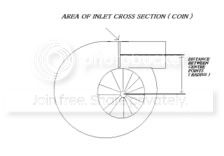
if it resizes , the text at the top says area of inlet cross section and is pointing at the 'coin', the two thick lines are where the radius is measured from
that is MY understanding anyway, i accept i'm probably wrong in a few areas
if you look at the where the housing begins, at it's inlet ( outlet for compressor housing) but where it's first at a 'cylinder shaped point' and measure the area at that point ( say you pushed a coin in as far as it could go, then measure the area of that coin ) now measure from the centre point of that coin to the centre point of the shaft, this is the 'R' (radius ) . divide this distance by the area of the coin and you get a your ratio;
so say the coin is 5cm in diameter, do piR2 to get area ( pi X radius squared ) coin = 19.635 cm
distance between centre of coin and shaft = 9cm
9 divided by 19.635 = A/R of 0.45
if you do this same process throughout the housing the ratio remains the same, because as the housing gets smaller, you are closer to the shaft
so A/R stands for 'Area of inlet cross section vs Radius
excuse the shoddy pic
if it resizes , the text at the top says area of inlet cross section and is pointing at the 'coin', the two thick lines are where the radius is measured from
that is MY understanding anyway, i accept i'm probably wrong in a few areas

15K+ Super Poster!!
Joined: May 2003
Posts: 15,885
Likes: 17
From: Stockport, Cheshire
Originally Posted by markk
so not many people know then ?
but that still doesnt explain a smaller A/R ratio being a much larger compressor ??
but that still doesnt explain a smaller A/R ratio being a much larger compressor ??
Trending Topics
so from a particular compressor housing without a part number to tie it to specific unit you have no idea of its output ?
sounds very strange to me, surely any given housing can only flow a certain amount of air, and the A/R must be relative to its size ?
sounds very strange to me, surely any given housing can only flow a certain amount of air, and the A/R must be relative to its size ?

PassionFord Post Whore!!
Joined: May 2003
Posts: 9,076
Likes: 0
From: Northants
A/R describes a geometric characteristic of all compressor and turbine housings. It is defined as the inlet cross-sectional area divided by the radius from the turbo centerline to the centroid of that area.
Compressor A/R - Compressor performance is largely insensitive to changes in A/R, but generally larger A/R housings are used to optimize the performance for low boost applications, and smaller housings are used for high boost applications. Usually there are not A/R options available for compressor housings.
Turbine A/R - Turbine performance is greatly affected by changing the A/R of the housing. Turbine A/R is used to adjust the flow capacity of the turbine. Using a smaller A/R will increase the exhaust gas velocity into the turbine wheel, causing the wheel to spin faster at lower engine RPMs giving a quicker boost rise. This will also tend to increase exhaust backpressure and reduce the max power at high RPM. Conversely, using a larger A/R will lower exhaust gas velocity, and delay boost rise, but the lower backpressure will give better high RPM power. When deciding between A/R options, be realistic with the intended vehicle use and use the A/R to bias the performance toward the desired powerband.
Compressor A/R - Compressor performance is largely insensitive to changes in A/R, but generally larger A/R housings are used to optimize the performance for low boost applications, and smaller housings are used for high boost applications. Usually there are not A/R options available for compressor housings.
Turbine A/R - Turbine performance is greatly affected by changing the A/R of the housing. Turbine A/R is used to adjust the flow capacity of the turbine. Using a smaller A/R will increase the exhaust gas velocity into the turbine wheel, causing the wheel to spin faster at lower engine RPMs giving a quicker boost rise. This will also tend to increase exhaust backpressure and reduce the max power at high RPM. Conversely, using a larger A/R will lower exhaust gas velocity, and delay boost rise, but the lower backpressure will give better high RPM power. When deciding between A/R options, be realistic with the intended vehicle use and use the A/R to bias the performance toward the desired powerband.
Football Cwazy
Joined: Oct 2004
Posts: 9,553
Likes: 0
From: Redditch, Worcestershire
Originally Posted by markk
so from a particular compressor housing without a part number to tie it to specific unit you have no idea of its output ?
sounds very strange to me, surely any given housing can only flow a certain amount of air, and the A/R must be relative to its size ?
sounds very strange to me, surely any given housing can only flow a certain amount of air, and the A/R must be relative to its size ?

Thread
Thread Starter
Forum
Replies
Last Post
mark94
Ford Mondeo Including ST
5
Oct 10, 2023 06:52 PM