


Photography 101 - Lesson one - Cameras and Lenses


Thread Starter
0-60 in 17 seconds (eek)
Joined: Apr 2004
Posts: 6,717
Likes: 0
From: Berkshire
 Photography 101 - Lesson one - Cameras and Lenses
Photography comes from the Greek words for light and writing. Essentially, writing with light.
The first thing we will discuss are the main parts of a camera, whether it be compact or SLR, film or digital.
Lenses
At the front of the camera is a lens, its responsiblity is to focus the light which comes from the subject being photographed onto the film or digital capture device (CCD) in a digital camera.
Generally made of glass, lenses can also be made of plastic in cheap cameras. The more expensive lenses are made of specially coated glass which improves the optical qualities of the lens, resulting in better picture quality.
The lens is also usually responsible for the focussing aspects of taking a photograph, in other words, it makes the light beams converge onto the film so that the recorded image is crisp.
There are three basic types of lenses; normal, wide angle and telephoto.
The lens's focal length determine the size of the image that will be recorded, a wide angle lens captures a wide angle of light and therefore is able to "fit" more onto the film, a telephoto lens on the other hand captures a narrow angle of light and therefore "fits" less on film.
If you think of the film as if it were your eyes, a telephoto lens would be the equivalent of using binoculars, you can see detail on things that are far away, but, they are no good for peripheral vision, which is what wide angle lenses are very good at.
Typically, a wide angle lens will have a focal lens which is less that 50mm, a normal lens will be 50 to 80mm, and a telephoto lens will be anything above 80mm (210mm for example).
Fixed focal lenses are just that, a lens which only has one focal length, whereas zoom lenses are able to cover a range of focal length, typical examples are: 28-80mm, 70-210mm, etc...
Zoom lenses are very practical since they cover a range which would otherwise require a number of lenses, which equates to weight and space savings in a camera bag. They also remove the need to change lenses when photographing different subjects.
Imagine that you are on a safari with some friends, and fit your 300mm fixed focal lens on your camera to take pictures of the wildlife, suddenly, someone near you pulls a face which you want to capture for posterity, you'd need to dig into your camera bag, pull out your 50mm lens, fit it onto the camera and take the picture, or, run 1/4 mile in the bush to be far away enough. Chances are that your friend will then have lost the expression, and the photo opportunity is gone.
A zoom lens on the other hand may have allowed you to take the picture by quickly zooming out.
Photography as you will see through the remainder of these articles, is a constant set of compromises you have to juggle, where whatever change you make will affect something else which will always affect the end result in one way or another.
In this instance, the compromise you would have made as a photographer would be to capture distant wildlife only, just like choosing to drive your Ferrari in the morning is a conscious decision that you will not be able to go off road unless you change the car.
There are drawbacks to zoom lenses however, because of their multipurpose, they are often a compromise in terms of quality, and a zoom lens which is equally as good as the three fixed focal lenses it replaces will usually cost significantly more.
Finally, the speed, or light-gathering power, of a lens is indicated by the f number, called the aperture.
The lower the f number, the faster the lens, that is, the more light it lets through. A fast lens has an aperture of at least f/2.8, the very best lenses can have apertures as low as f1 or even less.
We will go into more detail about the subject of aperture in later articles, however, for now, consider that a lens, however good it is, absorbs a certain amount of the light that's passing through it, the more it absorbs, the slower it is, conversely, the more transparent it is, the faster it is.
The reason for this is that the glass they are made of isn't 100% transparent to light, and within one lens, there may be several glass elements, all of which contribute to light losses.
Note that while fast lenses tend to be more expensive than their slow counterparts, a fast lens isn't necessarily a sign of good quality.
Often lenses are characterised by two numbers, for example, 50mm f/5.6, meaning the lens has a focal length of 50mm, and a maximum aperture of f5.6.
You may also see lenses with markings such as f/5.6-22 or f/5.6(22) meaning that the maximum aperture is f5.6, and the minimum aperture is f22.
Lastly, some zoom lenses will show markings such as f/4.5-5.6 which mean that at the lowest focal length, the lens' maximum aperture is f4.5, but at it's furthest zoom setting, the lens absorbs more light, therefore lowering the maximum aperture to f5.6.
Key thing to remember for now, is that when setting the lens aperture to f5.6, you are allowing more light to reach the internals of the camera than if you chose f22. It is completely counter-intuitive, since the larger numbers relate to less light, so best get used to it now
Image capture
Behind the lens is film or CCD (Charge Coupled Device) in digital cameras, this is what is sensitive to light in a camera, and records the image. An analogy for this would be the retina in your eyes. It receives light and turns it into an image.
Once exposed to light, the film or CCD records the light which it received and stores it chemically (in film), or, digitally for a CCD.
If the film or CCD receives too little light while it is exposed, the resulting image will appear dark, the photography term for such an image is under-exposed. If on the contrary it receives too much light, the resulting image will appear washed out, too bright, the term used here is over-exposed.
Just as your eyes have difficulty making things out in the dark, or, can't stand the brightness of the sun, film or CCD needs just the right amount of light to record a good picture. How this is done will be covered later.
Film is available in a number of sensitivities, known as ISO which express how much or how little light is required to correctly expose the film. CCDs in digital cameras replicate this by electronic means, again, we'll cover this in more detail later.
Viewfinder
The viewfinder is where you see what picture you are about to take. In an SLR, a mirror inside the camera is installed between the lens and the film, so that when looking through the viewfinder, you are looking at exactly what will appear on the photograph.
Non-SLR cameras on the other hand have a viewfinder which isn't 100% aligned with the lens.
When you press the shutter (the button that takes the picture), the mirror lifts and therefore exposes the CCD or film, resulting in an image being recorded. If you look carefully through the viewfinder in your SLR when you take a picture, you should notice that it goes black while the picture is taken, this shows that the mirror has lifted and closed the path of light through the lens to the viewfinder.
Non-SLR cameras use an optical viewfinder that was more or less aligned with the lens, sometimes resulting in framing errors, particularly on close objects due to a less than perfect alignment. More recently, digital compact cameras show the preview image on an LCD screen which shows what goes through the lens though.
In the next article, we will discuss exposure in more detail (https://passionford.com/forum/viewtopic.php?p=3784722).
The first thing we will discuss are the main parts of a camera, whether it be compact or SLR, film or digital.
Lenses
At the front of the camera is a lens, its responsiblity is to focus the light which comes from the subject being photographed onto the film or digital capture device (CCD) in a digital camera.
Generally made of glass, lenses can also be made of plastic in cheap cameras. The more expensive lenses are made of specially coated glass which improves the optical qualities of the lens, resulting in better picture quality.
The lens is also usually responsible for the focussing aspects of taking a photograph, in other words, it makes the light beams converge onto the film so that the recorded image is crisp.
There are three basic types of lenses; normal, wide angle and telephoto.
The lens's focal length determine the size of the image that will be recorded, a wide angle lens captures a wide angle of light and therefore is able to "fit" more onto the film, a telephoto lens on the other hand captures a narrow angle of light and therefore "fits" less on film.
If you think of the film as if it were your eyes, a telephoto lens would be the equivalent of using binoculars, you can see detail on things that are far away, but, they are no good for peripheral vision, which is what wide angle lenses are very good at.
Typically, a wide angle lens will have a focal lens which is less that 50mm, a normal lens will be 50 to 80mm, and a telephoto lens will be anything above 80mm (210mm for example).
Fixed focal lenses are just that, a lens which only has one focal length, whereas zoom lenses are able to cover a range of focal length, typical examples are: 28-80mm, 70-210mm, etc...
Zoom lenses are very practical since they cover a range which would otherwise require a number of lenses, which equates to weight and space savings in a camera bag. They also remove the need to change lenses when photographing different subjects.
Imagine that you are on a safari with some friends, and fit your 300mm fixed focal lens on your camera to take pictures of the wildlife, suddenly, someone near you pulls a face which you want to capture for posterity, you'd need to dig into your camera bag, pull out your 50mm lens, fit it onto the camera and take the picture, or, run 1/4 mile in the bush to be far away enough. Chances are that your friend will then have lost the expression, and the photo opportunity is gone.
A zoom lens on the other hand may have allowed you to take the picture by quickly zooming out.
Photography as you will see through the remainder of these articles, is a constant set of compromises you have to juggle, where whatever change you make will affect something else which will always affect the end result in one way or another.
In this instance, the compromise you would have made as a photographer would be to capture distant wildlife only, just like choosing to drive your Ferrari in the morning is a conscious decision that you will not be able to go off road unless you change the car.
There are drawbacks to zoom lenses however, because of their multipurpose, they are often a compromise in terms of quality, and a zoom lens which is equally as good as the three fixed focal lenses it replaces will usually cost significantly more.
Finally, the speed, or light-gathering power, of a lens is indicated by the f number, called the aperture.
The lower the f number, the faster the lens, that is, the more light it lets through. A fast lens has an aperture of at least f/2.8, the very best lenses can have apertures as low as f1 or even less.
We will go into more detail about the subject of aperture in later articles, however, for now, consider that a lens, however good it is, absorbs a certain amount of the light that's passing through it, the more it absorbs, the slower it is, conversely, the more transparent it is, the faster it is.
The reason for this is that the glass they are made of isn't 100% transparent to light, and within one lens, there may be several glass elements, all of which contribute to light losses.
Note that while fast lenses tend to be more expensive than their slow counterparts, a fast lens isn't necessarily a sign of good quality.
Often lenses are characterised by two numbers, for example, 50mm f/5.6, meaning the lens has a focal length of 50mm, and a maximum aperture of f5.6.
You may also see lenses with markings such as f/5.6-22 or f/5.6(22) meaning that the maximum aperture is f5.6, and the minimum aperture is f22.
Lastly, some zoom lenses will show markings such as f/4.5-5.6 which mean that at the lowest focal length, the lens' maximum aperture is f4.5, but at it's furthest zoom setting, the lens absorbs more light, therefore lowering the maximum aperture to f5.6.
Key thing to remember for now, is that when setting the lens aperture to f5.6, you are allowing more light to reach the internals of the camera than if you chose f22. It is completely counter-intuitive, since the larger numbers relate to less light, so best get used to it now
Image capture
Behind the lens is film or CCD (Charge Coupled Device) in digital cameras, this is what is sensitive to light in a camera, and records the image. An analogy for this would be the retina in your eyes. It receives light and turns it into an image.
Once exposed to light, the film or CCD records the light which it received and stores it chemically (in film), or, digitally for a CCD.
If the film or CCD receives too little light while it is exposed, the resulting image will appear dark, the photography term for such an image is under-exposed. If on the contrary it receives too much light, the resulting image will appear washed out, too bright, the term used here is over-exposed.
Just as your eyes have difficulty making things out in the dark, or, can't stand the brightness of the sun, film or CCD needs just the right amount of light to record a good picture. How this is done will be covered later.
Film is available in a number of sensitivities, known as ISO which express how much or how little light is required to correctly expose the film. CCDs in digital cameras replicate this by electronic means, again, we'll cover this in more detail later.
Viewfinder
The viewfinder is where you see what picture you are about to take. In an SLR, a mirror inside the camera is installed between the lens and the film, so that when looking through the viewfinder, you are looking at exactly what will appear on the photograph.
Non-SLR cameras on the other hand have a viewfinder which isn't 100% aligned with the lens.
When you press the shutter (the button that takes the picture), the mirror lifts and therefore exposes the CCD or film, resulting in an image being recorded. If you look carefully through the viewfinder in your SLR when you take a picture, you should notice that it goes black while the picture is taken, this shows that the mirror has lifted and closed the path of light through the lens to the viewfinder.
Non-SLR cameras use an optical viewfinder that was more or less aligned with the lens, sometimes resulting in framing errors, particularly on close objects due to a less than perfect alignment. More recently, digital compact cameras show the preview image on an LCD screen which shows what goes through the lens though.
In the next article, we will discuss exposure in more detail (https://passionford.com/forum/viewtopic.php?p=3784722).



Thread Starter
0-60 in 17 seconds (eek)
Joined: Apr 2004
Posts: 6,717
Likes: 0
From: Berkshire
Some examples of lenses and markings
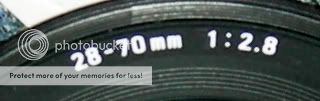
28-70mm zoom lens
Max aperture f2.8 throughout.
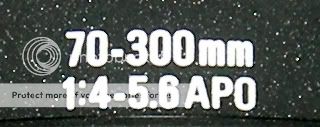
70-300 zoom lens
Max aperture f4.5 at 70mm, 5.6 at 300mm
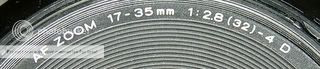
17-35mm zoom lens
Max aperture f2.8 at 17mm, f4 at 35mm, min aperture f32 (in brackets)
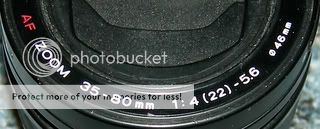
35-80mm zoom lens
Max aperture f4 at 35mm, f5.6 at 80mm, min aperture f22 (in brackets)
28-70mm zoom lens
Max aperture f2.8 throughout.
70-300 zoom lens
Max aperture f4.5 at 70mm, 5.6 at 300mm
17-35mm zoom lens
Max aperture f2.8 at 17mm, f4 at 35mm, min aperture f32 (in brackets)
35-80mm zoom lens
Max aperture f4 at 35mm, f5.6 at 80mm, min aperture f22 (in brackets)

Trending Topics




PassionFords Creator
iTrader: (12)
Joined: May 2003
Posts: 28,824
Likes: 95
From: Blackpool, UK Destination: Rev limiter
Moved to general discussion for peoples enjoyment Frog, these essays should be absorbed by as many people as possible after all your effort. 

PassionFords Creator
iTrader: (12)
Joined: May 2003
Posts: 28,824
Likes: 95
From: Blackpool, UK Destination: Rev limiter
Anyone who enjoys these, can find further lessons from Frog stickied in this room...
https://passionford.com/forum/viewforum.php?f=12

https://passionford.com/forum/viewforum.php?f=12



Virgin
Joined: Nov 2008
Posts: 1
Likes: 0
From: KUWAIT
thank you very very much mr. frog
great lesson ,i was looking for a long time
this is my fairst time in this fourm,
after i read your lesson i regestered specially to thank you frog
thank you very very much
looking forword to the nixt lesson..
best regards..
Hamid..
great lesson ,i was looking for a long time
this is my fairst time in this fourm,
after i read your lesson i regestered specially to thank you frog
thank you very very much
looking forword to the nixt lesson..
best regards..
Hamid..
Last edited by Hamid; Nov 13, 2008 at 08:06 AM.


Virgin
Joined: Jan 2010
Posts: 1
Likes: 0
From: tytuy
I accept with information:Imagine that you are on a safari with some friends, and fit your 300mm fixed focal lens on your camera to take pictures of the wildlife, suddenly, someone near you pulls a face which you want to capture for posterity, you'd need to dig into your camera bag, pull out your 50mm lens, fit it onto the camera and take the picture, or, run 1/4 mile in the bush to be far away enough. Chances are that your friend will then have lost the expression, and the photo opportunity is gone.
A zoom lens on the other hand may have allowed you to take the picture by quickly zooming out.
Photography as you will see through the remainder of these articles, is a constant set of compromises you have to juggle, where whatever change you make will affect something else which will always affect the end result in one way or another.
A zoom lens on the other hand may have allowed you to take the picture by quickly zooming out.
Photography as you will see through the remainder of these articles, is a constant set of compromises you have to juggle, where whatever change you make will affect something else which will always affect the end result in one way or another.


Thread
Thread Starter
Forum
Replies
Last Post
nicodinho
Ford Non RS / XR / ST parts for sale.
6
Oct 7, 2015 12:56 PM
