Something I have also been wondering about is whether the stiffness of the anti roll bars are really significant compared to the stiffness of the springs. Some people remove the front ani roll bar in order to fit compression struts. I wouldn't think that would be a good idea, but I could never put any numbers to it.
But now I found a formula to rougly calculate the spring rate of an anti roll bar:
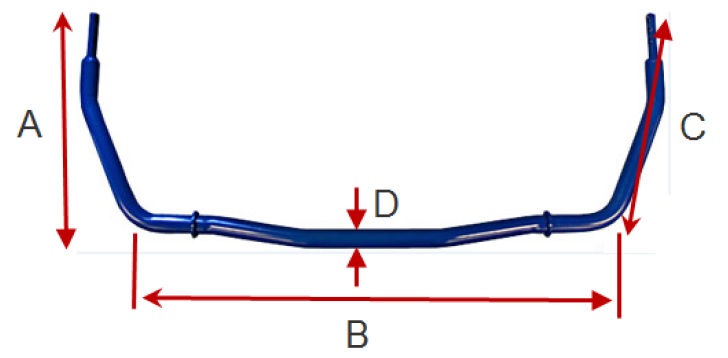
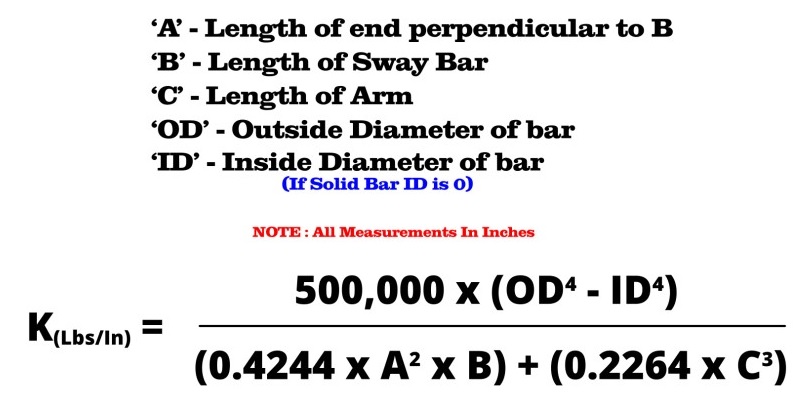
So I measured the A, B, C and D dimensions for the front and rear anti roll bars and put them into Excel again to calculate the spring rates.
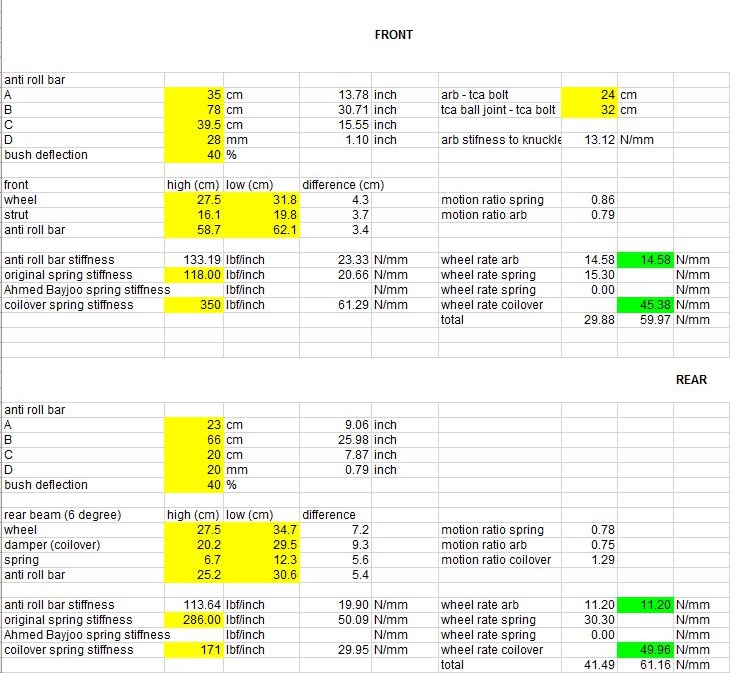
The spring rates themselves cannot be compared directly to the spring rates of the coil springs because the arbs are mounted in bushes and are acting at different positions on the suspension arms then the coil springs. So I multiplied the arb stiffness with a percentage for the deflection of the arb rubbers/bushes. The less the bushes deflect the better the arb will work.
And to be able to compare the arb spring rates with the coil spring spring rates I measured the motion ratios for both the arb and the coil springs. If you convert the spring rate with the motion ratio you get the wheel rate, which is really the spring stiffness as seen at the wheel.
I converted all the spring rates from lbf/inch to N/mm because I don't really like the imperical system.

For the 28 mm thick front arb I used a bush deflection of 40% for the standard bushes, which gives a wheel rate of 14.58 N/mm. The original front springs on a sapph are 118 lbf/inch which give a wheel rate of 15.3 N/mm. So it seems like the arb and coil spring are just about as stiff originally. But that isn't actually true. Because when the arb moves up on the outer wheel during cornering it moves down by the same amount on the inner wheel. So that means you have twice as much travel on the arb, which means the force is also twice as much. So you should actually compare 29.2 N/mm for the arb with 15.3 N/mm for the coil spring. So on a standard car the arb is doing double the work of the coil spring in keeping the car level during cornering.
With typical coilovers springs of 350 lbf/inch the springs are about 3 times as stiff as original. So in that case the springs are doing more than the arb, but not by a huge amount. My car is still on the Ahmed Bayjoo springs, but according to Mike Rainbird those spring rates are close to the coilover spring rates I used here.
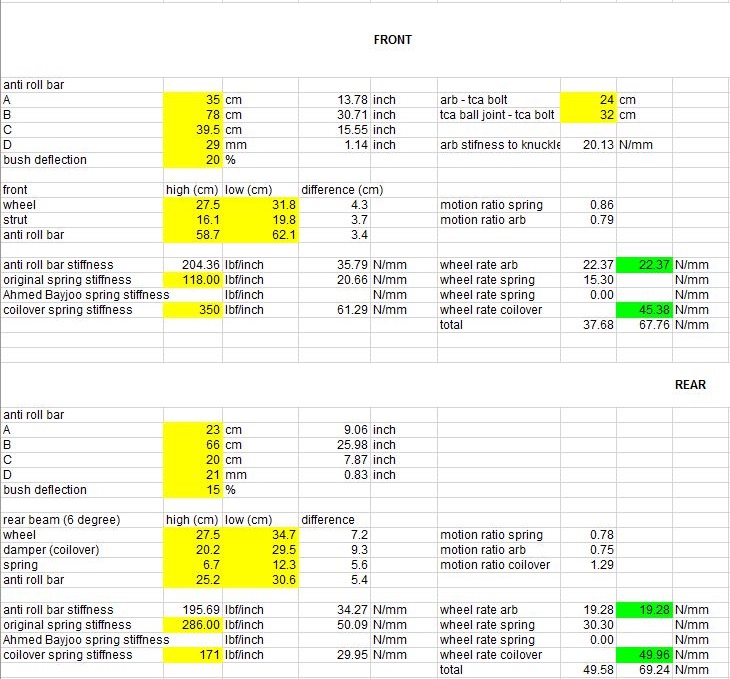
Last year I swapped the 28 mm Sapph 4x4 front arb for a 29 mm arb off an Escort Cosworth. Together with that I fitted some purple Powerflex arb to chassis bushes and black Powerflex arb to tca bushes. With those changes I estimated the bush deflection to 20%. This now gives the arb a wheel rate of 22.37 N/mm, which means it should now be about as stiff as the Ahmed Bayjoo springs.
Maybe this can be of some use to someone.
