Originally Posted by
boothy
what do they actually do apart from camber,are they worth it for road and little track use? also does it wear the tyres out

if you imagine that the wheels camber is dead straight at standard ride height, if you then lower a car your shortening the normal height of the hub from the body of the car and because the hubs only point of pivioting is from the TCAs this puts the bug at a different angle as apposed to dead straight. so therefore your tyres wera out heavily on the inner edges. this is good for track as when you go round a rght hand corner for example the weight shifts to the left hand wheel, if the wheel is dead straight camber then some of the tyre will loose traction with the road, but if its allready on a negative camber (from having the suspension height changed) then you are increasing the amount of tyre that is touching the road when going aroudn the corner. its a rough explinatin but i hope you get what i mean?
another example is range rovers, they all have air suspension and you have 3 settings, off road (really high) puts the wheels in positive camber normal ride height puts them roughly straight and acess (lower to the floor) puts them at negative camber.
heres an explination from GT vault:
Camber is the angle of the wheels in relation to the ground. The tire's relationship with the road changes as the suspension moves through its travel.
Ideally, you want a camber curve that keeps the tire straight up and down when you are driving straight, and leans the tire in slightly (1 to 2 degrees of negative camber) during cornering.
So a neutral camber will be |-| (while looking at the car front on),
A Negative Camber will be /-\,
And a Positive camber will be \-/.
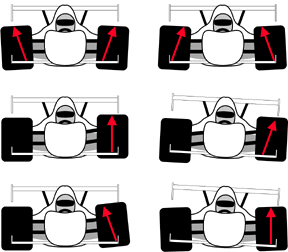
(TOP LEFT) Positive camber: The bottoms of the wheels are closer together than the tops.
(TOP RIGHT) Negative camber: The tops of the wheels are closer together than the bottoms.
(CENTER) When a suspension does not gain camber during deflection, this causes a severe positive camber condition when the car leans during cornering. This can cause funky handling.
(BOTTOM) Fight the funk: A suspension that gains camber during deflection will compensate for body roll. Tuning dynamic camber angles is one of the black arts of suspension tuning.
Camber allows the weight of the car lean on the outer tires, providing additional contact in a corner. However, on level ground and straights, the more camber you have the less contact surface area the tire has to the road.
Thus a negative camber in the front tires is always recommended, and in most situations the front camber value should be higher than the rear. Rear camber should be as close to Zero or neutral as much as possible. Thus, providing as much grip to the rear as possible. Unless you are tuning to reduce oversteer, then a little negative camber is okay. On oval tracks, the inner wheels will need positive camber and the outer wheels will need negative camber to counter the angle of the track. Using camber to reduce oversteer and understeer should be treated as a secondary option to adjusting springs and shocks first. Unless you are intentionally tuning for a drift car. 4WD and FWD recommendations, start at default value 2.1 and adjust up to a value of 4. RWD recommendations, start at 2.1 and adjust up to a value of 3.