


When do the standard exhaust ports become restrictive?


 When do the standard exhaust ports become restrictive?
A mate of mine runs a EFI RST, 1.6cc, CR 8:5.1, Kent CVH 35, and a Stage 3 T3 (.48/55), but with an untouched head, and it makes peek boost (24psi) at 4000rpm and then pretty much holds 21psi till the limiter.
I know Stage 3 T3's are laggy, and the cam too but I was wondering if the exhaust ports are holding it back on spool up?
Thats a big arse turbine housing and tiny ports feeding it, thought maybe some port work might get it spooling faster?!
What are your thoughts and experiences...
I know Stage 3 T3's are laggy, and the cam too but I was wondering if the exhaust ports are holding it back on spool up?
Thats a big arse turbine housing and tiny ports feeding it, thought maybe some port work might get it spooling faster?!
What are your thoughts and experiences...
Last edited by Karlos G; Feb 19, 2010 at 09:53 PM.


that's really laggy pal, my 1,8zvh makes boost of 21psi at 3250rpm on a t3 cossie 4wd turbo, so basically the same.
i have a ported head though and only a standard cam, so i would suggest porting would help.
not an exact comparrison due to my extra capacity, but i'd reckon a drop of 250-500rpm due to the porting could be achieved on spooling.
i have a ported head though and only a standard cam, so i would suggest porting would help.
not an exact comparrison due to my extra capacity, but i'd reckon a drop of 250-500rpm due to the porting could be achieved on spooling.

Shit me thats laggy! i nearly bought a .48 t3 recently for mine.... glad i didn't lol Karl the honest answer is that i don't know. However..... There is a certain amount of gas in each cylinder, this will be the same regardless of exhaust port size, the same amount of gas will be pushed out through the exhaust port regardless.... so i don't think it will help, i know porting the exhaust in reality DOES help however i think on this occasion porting of the inlet would have a larger effect on turbo spall..... but i stand to be corrected.
The more air you can get into each cylinder (off boost) the better, i know that porting the inlet (on a restrictive head) has a larger effect on VE than porting the exhaust. So aside from this a smoother cam lol..... although its probably pretty smooth any way (like round) being a kent lol
Simple answer is port both lol
Rob,
The more air you can get into each cylinder (off boost) the better, i know that porting the inlet (on a restrictive head) has a larger effect on VE than porting the exhaust. So aside from this a smoother cam lol..... although its probably pretty smooth any way (like round) being a kent lol
Simple answer is port both lol
Rob,
Last edited by Rob_DOHC; Feb 19, 2010 at 09:23 PM.
I don't know mate, would be nice to see some graphs of different set ups etc. I was all set to buy a .48 t3 with 360 deg thrust (so i guess a stage 3.....that right karlos?) but think for now i will stick with a .36 2wd jobbie.
Rob,
Rob,

PassionFord Post Whore!!

Joined: Jan 2007
Posts: 4,995
Likes: 14
From: merseyside
have you seen the shape of a standard cvh exhaust ports THERE SHIT..... i have been telling you guys for years that its the exhaust side of cvh heads that you need to work first .
Trending Topics
Im not saying there good, if you say there shite then they WILL be a power limiter, however im not sure that JUST porting the exhaust side would reduce lag (the topic)... or at least as much as a really good inlet would. But again, prepared to be wrong, just want to know why as well as 'if it would' (if that makes sense?).
PassionFord Post Whore!!
Joined: Jan 2007
Posts: 4,995
Likes: 14
From: merseyside
Shit me thats laggy! i nearly bought a .48 t3 recently for mine.... glad i didn't lol Karl the honest answer is that i don't know. However..... There is a certain amount of gas in each cylinder, this will be the same regardless of exhaust port size, the same amount of gas will be pushed out through the exhaust port regardless.... so i don't think it will help, i know porting the exhaust in reality DOES help however i think on this occasion porting of the inlet would have a larger effect on turbo spall..... but i stand to be corrected.
The more air you can get into each cylinder (off boost) the better, i know that porting the inlet (on a restrictive head) has a larger effect on VE than porting the exhaust. So aside from this a smoother cam lol..... although its probably pretty smooth any way (like round) being a kent lol
Simple answer is port both lol
Rob,
The more air you can get into each cylinder (off boost) the better, i know that porting the inlet (on a restrictive head) has a larger effect on VE than porting the exhaust. So aside from this a smoother cam lol..... although its probably pretty smooth any way (like round) being a kent lol
Simple answer is port both lol
Rob,
p-s on a n/a head the exh side should flow about 70% of the inlet side but on a turbo engine you want the exh side to flow 90% min of the inlet side and none of the standard cvh heas do .
Last edited by crazycage; Feb 19, 2010 at 09:35 PM.
Comparing the ZVH is not really applicable as an extra 200CC can make a huge difference, ZVH are well known for fast spooling times for this very reason.
Rob if you bought a .48 housing it would make it a stage 2 unless your compressor wheel is bigger too? Although I would imagine it would behave more like a stage 3 as it's the turbine side that plays the biggest part in lag.
I agree about the volume of gasses in the chambers being finite but my thinking was that the quicker the engine can exhaust them the faster the turbo will spool, and in turn the faster it can take fresh gasses in, making the whole engine more responsive............ this is of course to the point where gas velocity drops too low and you get the opposite effect, and of course if the ports are restrictive in the first place!?
If it is this whats causing the lag, in conjunction with the agressive cam profile (or maybe lack of profile as it's done a few miles?!), then maybe some porting is the way forward!?
FYI it makes 7psi by 3000rpm, 15psi by 3500, then peeks at 24psi bang on 4000rpm.
Rob if you bought a .48 housing it would make it a stage 2 unless your compressor wheel is bigger too? Although I would imagine it would behave more like a stage 3 as it's the turbine side that plays the biggest part in lag.
I agree about the volume of gasses in the chambers being finite but my thinking was that the quicker the engine can exhaust them the faster the turbo will spool, and in turn the faster it can take fresh gasses in, making the whole engine more responsive............ this is of course to the point where gas velocity drops too low and you get the opposite effect, and of course if the ports are restrictive in the first place!?
If it is this whats causing the lag, in conjunction with the agressive cam profile (or maybe lack of profile as it's done a few miles?!), then maybe some porting is the way forward!?
FYI it makes 7psi by 3000rpm, 15psi by 3500, then peeks at 24psi bang on 4000rpm.
Last edited by Karlos G; Feb 19, 2010 at 09:53 PM.
the compressor wheel is what gives the boost increase, the bigger, the more boost, in order of size it goes erst T3, 2wd T3, 4wd T3, T34 and so on.
ballbearing ones spool earlier so tend to have bigger compressor wheels too.
I agree with you totally mate, less restriction to flow on the exhaust side is generally a good thing, but the post is about lag, not power.
I think about it like this.
You have a certain amount of air in a cylinder at the bottom of the stroke, at tdc that same amount of gas HAS been forced out of the cylinder regardless of restriction (to a certain extent agreed). Now port the inlet, more air is now in the cylinder, so more air has to be forced out of the cylinder in the same amount of time..... more gas (time constant) means there is more energy to spool the turbo up.
Its whether or not a restrictive exhaust port effects gas velocity, volume etcetc in a way that effect lag (i cant see that it would effect volume due to the above) and tbh i don't know enough behind the principals to say.
Rob,
I think about it like this.
You have a certain amount of air in a cylinder at the bottom of the stroke, at tdc that same amount of gas HAS been forced out of the cylinder regardless of restriction (to a certain extent agreed). Now port the inlet, more air is now in the cylinder, so more air has to be forced out of the cylinder in the same amount of time..... more gas (time constant) means there is more energy to spool the turbo up.
Its whether or not a restrictive exhaust port effects gas velocity, volume etcetc in a way that effect lag (i cant see that it would effect volume due to the above) and tbh i don't know enough behind the principals to say.
Rob,
You can get to the point where not all the gasses are forced out though, that is where porting, bigger exhaust housings, and longer duration cams come into play to allow you to get more from the engine, but as you say Rob it's not what this thread is about.
I'm just wondering with the above spec if the ports are stifling the engine a little, and if the gasses could escape quicker if the ports where bigger..... it could of course be that the inlet ports that are restricting on the way in and that the exhaust ports still have plenty of headroom?!
I dont know...
I'm just wondering with the above spec if the ports are stifling the engine a little, and if the gasses could escape quicker if the ports where bigger..... it could of course be that the inlet ports that are restricting on the way in and that the exhaust ports still have plenty of headroom?!
I dont know...
Comparing the ZVH is not really applicable as an extra 200CC can make a huge difference, ZVH are well known for fast spooling times for this very reason.
Rob if you bought a .48 housing it would make it a stage 2 unless your compressor wheel is bigger too? Although I would imagine it would behave more like a stage 3 as it's the turbine side that plays the biggest part in lag.
I agree about the volume of gasses in the chambers being finite but my thinking was that the quicker the engine can exhaust them the faster the turbo will spool, and in turn the faster it can take fresh gasses in, making the whole engine more responsive............ this is of course to the point where gas velocity drops too low and you get the opposite effect, and of course if the ports are restrictive in the first place!?
If it is this whats causing the lag, in conjunction with the agressive cam profile (or maybe lack of profile as it's done a few miles?!), then maybe some porting is the way forward!?
FYI it makes 7psi by 3000rpm, 15psi by 3500, then peeks at 24psi bang on 4000rpm.
Rob if you bought a .48 housing it would make it a stage 2 unless your compressor wheel is bigger too? Although I would imagine it would behave more like a stage 3 as it's the turbine side that plays the biggest part in lag.
I agree about the volume of gasses in the chambers being finite but my thinking was that the quicker the engine can exhaust them the faster the turbo will spool, and in turn the faster it can take fresh gasses in, making the whole engine more responsive............ this is of course to the point where gas velocity drops too low and you get the opposite effect, and of course if the ports are restrictive in the first place!?
If it is this whats causing the lag, in conjunction with the agressive cam profile (or maybe lack of profile as it's done a few miles?!), then maybe some porting is the way forward!?
FYI it makes 7psi by 3000rpm, 15psi by 3500, then peeks at 24psi bang on 4000rpm.
 ) in at the same rate. if you are talking about things other than lag, less restriction to flow mean less energy is absorbed in pushing the gasses out (less energy wasted), and yep i agree too big and you loose gas velocity etcetc,
 Ah good to know about the turbo stuff Karlos.
0.48 t3 with 360 bearing would be a a stage one with different housing.
the compressor wheel is what gives the boost increase, the bigger, the more boost, in order of size it goes erst T3, 2wd T3, 4wd T3, T34 and so on.
ballbearing ones spool earlier so tend to have bigger compressor wheels too.
the compressor wheel is what gives the boost increase, the bigger, the more boost, in order of size it goes erst T3, 2wd T3, 4wd T3, T34 and so on.
ballbearing ones spool earlier so tend to have bigger compressor wheels too.
Cheers
Rob,

You can get to the point where not all the gasses are forced out though, that is where porting, bigger exhaust housings, and longer duration cams come into play to allow you to get more from the engine, but as you say Rob it's not what this thread is about.
I'm just wondering with the above spec if the ports are stifling the engine a little, and if the gasses could escape quicker if the ports where bigger..... it could of course be that the inlet ports that are restricting on the way in and that the exhaust ports still have plenty of headroom?!
I dont know...
I'm just wondering with the above spec if the ports are stifling the engine a little, and if the gasses could escape quicker if the ports where bigger..... it could of course be that the inlet ports that are restricting on the way in and that the exhaust ports still have plenty of headroom?!
I dont know...
I have read (somewhere on here) that the exhaust valves were pretty large as standard, this would lead me to believe the port is probably big enough for normal(ish) powers, but can't remember where i read that.
 lol
lol2wd T3 is like a stage 2 .36/55 same as what i'm running, so if you added the .48 it would indeed be like a stage 3!
Back on topic....
I'd try dialing in a few degrees of cam advance to bring things into life a bit earlier but he has no vernier, so dont know what else to try...

PassionFord Post Whore!!
Joined: Jan 2007
Posts: 4,995
Likes: 14
From: merseyside
i will try and take a pic of the worst part of the exhaust port later today if i get the time , but its in the left and right corners on the short side radius ,theres about a 4mm sep!!! not good for gas flow in a big way and anyone with a good eye and a steady hand could blend that out easy without fucking up the port .
Yeah any step anywhere in any port is a bad idea for flow, shame I dont have a untouched head to peek at myself!
So do you think this could be the cause of the lag Crazycage?
So do you think this could be the cause of the lag Crazycage?
Last edited by Karlos G; Feb 20, 2010 at 09:20 AM.
PassionFord Post Whore!!
Joined: Jan 2007
Posts: 4,995
Likes: 14
From: merseyside

Too many posts.. I need a life!!
Joined: Apr 2007
Posts: 934
Likes: 0
From: worcester
IMO if you port the exhaust ports you will get better gas flow which will then make a better spool up on the inlet side. But the problem is i think that you are then restricted as the inlet is now trying to pass more air but still restrictive. IMO i would port both but i think the exhaust port would be the main advantage because if you ported the inlet you are still not getting the gasses out any quicker
Yeah it ll depends on where the restriction (if any) actually is, there might be plenty of headroom on the inlet side and it's the exhaust is restrictive, or it could be the other way round with there being plenty of headroom on the exhaust side and it's the inlet being restrictive............... but as you say if both are done then you cant go wrong! lol
All I really need to know is if it is the standard ports causing the lag or if it's something else?!
All I really need to know is if it is the standard ports causing the lag or if it's something else?!
Last edited by Karlos G; May 2, 2010 at 06:00 PM.
Too many posts.. I need a life!!
Joined: Apr 2007
Posts: 934
Likes: 0
From: worcester
I think its the head personally, unless the 1600cc is just a tiny bit too small for the turbo but i cant see it being that. As you say the head has been untouched and a turbo that size is going to blow some air. The cam is helping but those ports are asking to be opened up. Maybe match the manifold too.

Part of the Furniture
Joined: Aug 2009
Posts: 192
Likes: 2
From: hatch end
i dont know if this helps but i had an erst about 7 years ago that i spent alot of money on including a universal turbo's stg 3 t3 a vulcan engineering ported andpolished big valve head with a cvh 34 cam and a front mount grs oh and the inlet manifold and injector rail were matched to the head and it was still quite laggy and wouldn't hit full boost til about 3800rpm but that was on mfi
Part of the Furniture
Joined: Aug 2009
Posts: 192
Likes: 2
From: hatch end
yeah mate no metering head to get in the way lol. my broyher has a an all blue cabby wit a 2.1 zvh thats got practically no lag on a stg3 t3 and has a power graph from torque of the devil for 296bhp and 341torque @23psi on dta

i will try and take a pic of the worst part of the exhaust port later today if i get the time , but its in the left and right corners on the short side radius ,theres about a 4mm sep!!! not good for gas flow in a big way and anyone with a good eye and a steady hand could blend that out easy without fucking up the port .
Yeah that would actually be really handy mate, im about to port my head after quite a bit of cvh head research lol looking up the exhuast port i see what you mean, my ports look pretty straight forward tho, so not sure if the head has been messed with in the past?!?!? I will post up pics tomorrow as well any how see what you think.
Engine is now out my car
feeling knackered, was bloody cold lolRob,
IMO if you port the exhaust ports you will get better gas flow which will then make a better spool up on the inlet side. But the problem is i think that you are then restricted as the inlet is now trying to pass more air but still restrictive. IMO i would port both but i think the exhaust port would be the main advantage because if you ported the inlet you are still not getting the gasses out any quicker
The gasses will be exiting at the same rate what ever you do the the exhaust side mate, the piston makes sure of that.
Had a chat with a mate today who is pretty knowledgeable with heads etc, admittedly more so on the A series. He agrees that porting the exhuast will have little effect on lag for the above reasons, however he did point out that if you only sorted the exhaust port (and if it was restrictive) the car would naturally be making more power/torque off boost due to a slightly larger VE the car could come on boost faster if this were the case.
Rob,
The gasses will exit faster the more there is (if your running higher boost for example) as the pressure in the chambers will be higher, also it may not be the gas velocity that effects the spool up time in this case, we have increased the size of the turbine housing and so maybe it needs a greater volume of gasses to spool it up faster (which is fine as we are running higher boost) but perhaps the ports are not big enough to flow this extra volume fast enough............ this is what I'm thinking any way!
The gasses will exit faster the more there is (if your running higher boost for example) as the pressure in the chambers will be higher
Last edited by Rob_DOHC; Feb 20, 2010 at 11:05 PM.

I've found that life I needed.. It's HERE!!
Joined: Aug 2006
Posts: 1,063
Likes: 0
From: The Netherlands
The gasses won't be exiting at the same rate, because of a eventually restriction in flow. If the exhaust port is extreme small this will cause a powerdrop ofcourse, but also the pressure in the cylinder on TDC will be higher then with a right ported head.
I think your forgetting the pressure on TDC.. The pressure on the time isn't always atmosferic. If it flows good you will have a under pressure which causes a higher velocity of gasses entering --> Helping your turbo to spool.
Also a under pressure wil be caused by a high exiting velocity of the exhaustgasses. Also high velocity will make sure the gasses have a high energy when hitting the turbo --> Less lag?
Bit different from the story so far, so i'm really curious to your reactions. I'm i right or am i missing somthing

Too many posts.. I need a life!!
Joined: May 2004
Posts: 499
Likes: 0
From: west midlands
you need the right mixture of everything really, when my cab was mapped (admittedly it was a 1900 cvh not a 1600 so would be less laggy anyway) it had a stage 3 ported polished big valve head, port matched inlet, cvh34 cam, and a t3 with a .48 housing, 360 bearing, but the rest of the turbo spec was unknown,it only did 210bhp with 250lb/ft, it was on full boost before 3000rpm, peak torque was at 3500rpm, but after 5000rpm it wouldnt make anymore power what so ever, jamie said the turbo was restricting it and holding it back, and as said above that was with a .48 t3 and a good spec head and cam which had done 246bhp on a previous car so we knew the head wasnt the problem, but the compressor side of the turbo was completley unknown which we think is what was holding it back.
exactly sir, so the higher the cylinder filling the faster (and greater volume) the gasses will be exhausted lol so to increase cylinder filling (more gas) you could for example change the cam (so volumetric efficiency is greater at a lower rpm) and port the inlet (clearly you would do the inlet and exhaust). There is more gas in the cylinder to be pushed out in the SAME amount of time, tbh i think volume is much more important than velocity up until a point in turbo spool up. Looking today, i think the ports are big enough to flow enough lol they are pretty massive! even as standard. I agree with crazy cage that improvements can be made however they will not be vast, at least not as vast, or important as the inlet.
I think you got it wrong on this one mate...
The gasses won't be exiting at the same rate, because of a eventually restriction in flow. If the exhaust port is extreme small this will cause a powerdrop ofcourse, but also the pressure in the cylinder on TDC will be higher then with a right ported head.
I think your forgetting the pressure on TDC.. The pressure on the time isn't always atmosferic. If it flows good you will have a under pressure which causes a higher velocity of gasses entering --> Helping your turbo to spool.
Also a under pressure wil be caused by a high exiting velocity of the exhaustgasses. Also high velocity will make sure the gasses have a high energy when hitting the turbo --> Less lag?
Bit different from the story so far, so i'm really curious to your reactions. I'm i right or am i missing somthing
The gasses won't be exiting at the same rate, because of a eventually restriction in flow. If the exhaust port is extreme small this will cause a powerdrop ofcourse, but also the pressure in the cylinder on TDC will be higher then with a right ported head.
I think your forgetting the pressure on TDC.. The pressure on the time isn't always atmosferic. If it flows good you will have a under pressure which causes a higher velocity of gasses entering --> Helping your turbo to spool.
Also a under pressure wil be caused by a high exiting velocity of the exhaustgasses. Also high velocity will make sure the gasses have a high energy when hitting the turbo --> Less lag?
Bit different from the story so far, so i'm really curious to your reactions. I'm i right or am i missing somthing
This is exactly what happens when you reach the maximum flow rate of the .36 housing, the gasses cannot exhaust any faster and so you cannot increase further the flow of fresh gasses in (no relevance to spool up, but just an example of exhaust restriction), at which point you would need a .48 housing to increase VE and continue.
you need the right mixture of everything really, when my cab was mapped (admittedly it was a 1900 cvh not a 1600 so would be less laggy anyway) it had a stage 3 ported polished big valve head, port matched inlet, cvh34 cam, and a t3 with a .48 housing, 360 bearing, but the rest of the turbo spec was unknown,it only did 210bhp with 250lb/ft, it was on full boost before 3000rpm, peak torque was at 3500rpm, but after 5000rpm it wouldnt make anymore power what so ever, jamie said the turbo was restricting it and holding it back, and as said above that was with a .48 t3 and a good spec head and cam which had done 246bhp on a previous car so we knew the head wasnt the problem, but the compressor side of the turbo was completley unknown which we think is what was holding it back.
Here is my NMS headwork so you can see that Karl Norris thinks is important to remove/open up on a CVH head.
When we spec'd it I asked for a head that would be responsive as well as flow greater than standard but not at the cost of gas velocity to the point of causing extra lag and this is what I got.....
Inlet


Exhaust


Pics of a untouched head would be nice for comparison!
Last edited by Karlos G; Feb 21, 2010 at 09:28 AM.
I think you got it wrong on this one mate...
The gasses won't be exiting at the same rate, because of a eventually restriction in flow. If the exhaust port is extreme small this will cause a powerdrop ofcourse, but also the pressure in the cylinder on TDC will be higher then with a right ported head.
I think your forgetting the pressure on TDC.. The pressure on the time isn't always atmosferic. If it flows good you will have a under pressure which causes a higher velocity of gasses entering --> Helping your turbo to spool.
Also a under pressure wil be caused by a high exiting velocity of the exhaustgasses. Also high velocity will make sure the gasses have a high energy when hitting the turbo --> Less lag?
Bit different from the story so far, so i'm really curious to your reactions. I'm i right or am i missing somthing
The gasses won't be exiting at the same rate, because of a eventually restriction in flow. If the exhaust port is extreme small this will cause a powerdrop ofcourse, but also the pressure in the cylinder on TDC will be higher then with a right ported head.
I think your forgetting the pressure on TDC.. The pressure on the time isn't always atmosferic. If it flows good you will have a under pressure which causes a higher velocity of gasses entering --> Helping your turbo to spool.
Also a under pressure wil be caused by a high exiting velocity of the exhaustgasses. Also high velocity will make sure the gasses have a high energy when hitting the turbo --> Less lag?
Bit different from the story so far, so i'm really curious to your reactions. I'm i right or am i missing somthing
Thats cool mate, and i agree with you on some points, however the cvh does not have tiny exhaust ports, as crazy cage said, looking at them you can see areas where they could be improved, but they are no pee shooters lol.
Karlos, i will take a photo of the standard ports today, where the inlets look totally different to yours, the exhaust ports don't look too different, yours have been opened up and slightly reshaped but not by a huge amount.
you will have a under pressure which causes a higher velocity of gasses entering
Good old topic this actually karlos.... But i think you already have your answer mate.
Yes, porting will reduce lag (non of us disagree on this lol) port the inlet and the exhaust side....
Yeah makes a change not to have a massive argument in a thread!!! lol
Get your pics up Rob, been so long since i've seen a untouched head I have no idea what they look like!!
Get your pics up Rob, been so long since i've seen a untouched head I have no idea what they look like!!
Right here are some terrible photos  Sorry it was raining and starting to get dark, and the camera wouldn't focus on the valve urggggh couldn't be arsed to get the slr grubby.
Only pictures of exhaust side as i haven't touched the engine yet, so inlet manifold is still on.

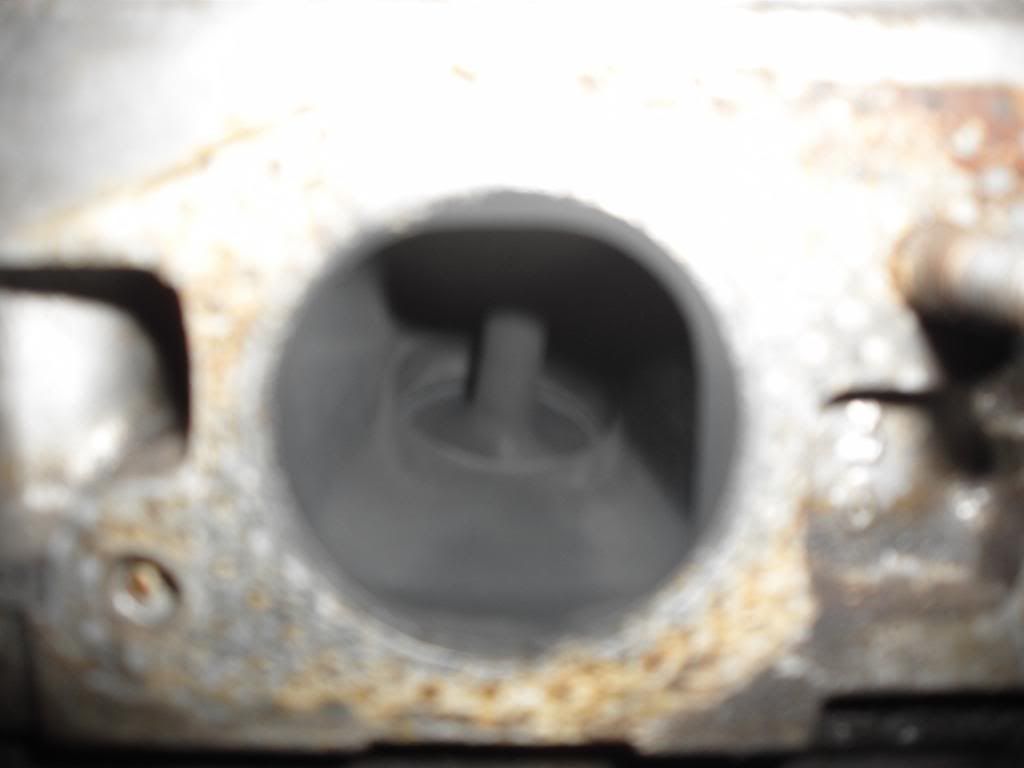

You can see what crazy cake is on about, but other than that the ports are straight and pretty massive. I will be smoothing the port out around the back of the valve.
Rob,
Sorry it was raining and starting to get dark, and the camera wouldn't focus on the valve urggggh couldn't be arsed to get the slr grubby. Only pictures of exhaust side as i haven't touched the engine yet, so inlet manifold is still on.
You can see what crazy cake is on about, but other than that the ports are straight and pretty massive. I will be smoothing the port out around the back of the valve.
Rob,
Too many posts.. I need a life!!
Joined: Apr 2007
Posts: 934
Likes: 0
From: worcester
Looking at the pictures there is quite a lot of difference around the valve. Another thing i was going to mention and what rob bought up was cams. Surley they will play a big fact on valve lift and duration for gas flow. Im running a power engineering stage 3 head and there own regrind cam sx428t. I have just bought my t3 stage 3 so will let you all know. It wont be for a few months tho lol