A short while ago I did some calculations for the Sierra rear beam and posted them on a different forum (fordpower.org.uk). The calculations are for a standard beam versus 6 degree beam (both slightly lowered). Calculations for the Granada mk3 would be slightly different because of the 2 cm wider track, higher ride height and bigger tyre diameter.
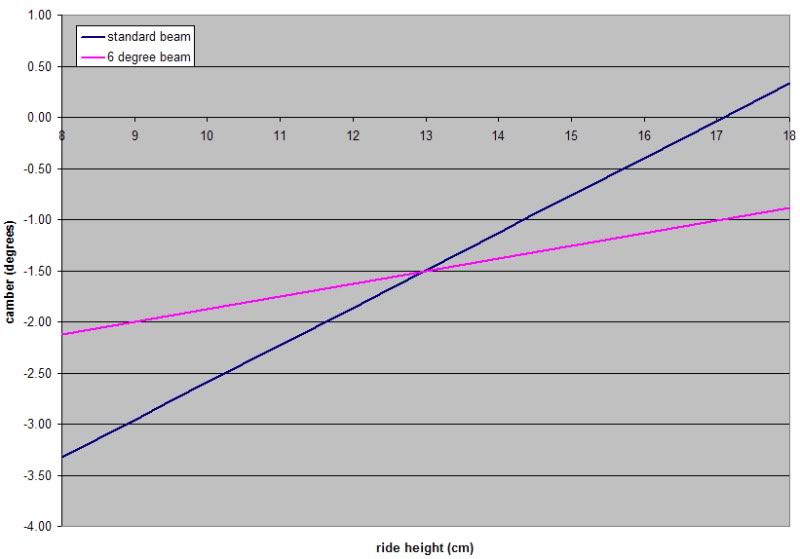
This graph shows the camber curves for the suspension travel. Normal ride height is at 13 cm (bottom beam to ground). I've fitted the camber curve to -1.5 degrees at normal ride height, as that is what is assumed optimal. You can see the camber gain on the 6 degree beam is a lot less, which is nice for grip during acceleration and heavy loads in the boot.
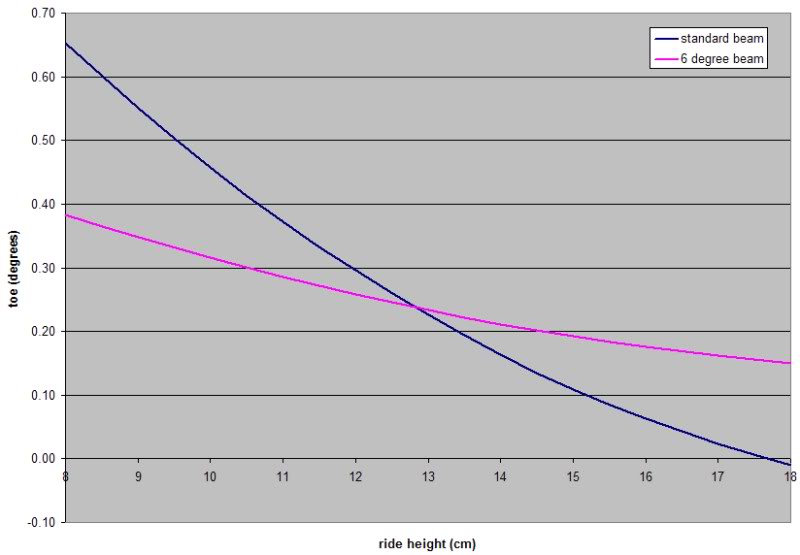
The next graph shows the toe curves for the suspension travel. I've fitted the toe curve to 0.23 degrees toe in (about 1.5 mm toe in each side with 15" wheels). The 6 degree beam also changes toe a lot less compared to the standard beam.
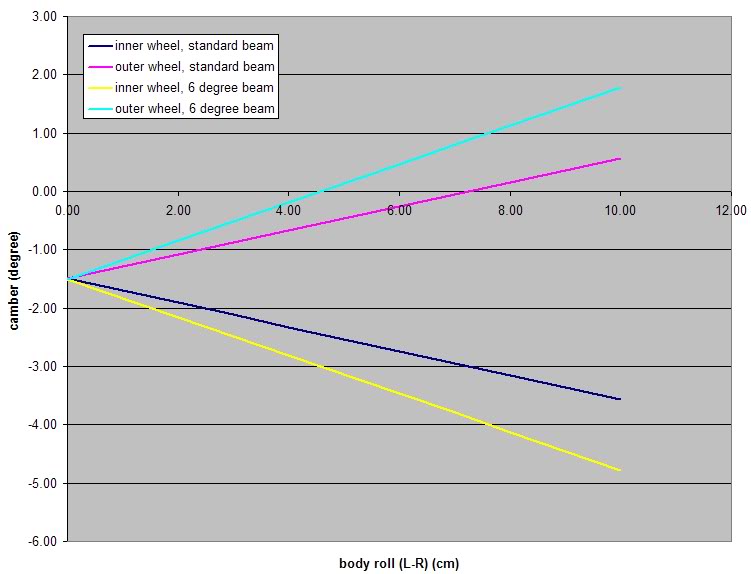
I thought it would also be nice to see the camber while cornering. So I calculated the camber corrected for the roll angle, the graph shows the camber of both wheels as a function of the roll in cm between left and right wheel (2 cm roll is 1 cm compression on outer wheel and 1 cm rebound on the inner wheel, compared to the track width). It shows that the standard beam actually has nicer camber curves while cornering. During hard cornering the wheels stay flatter on the road compared to the 6 degree beam.
The last graph I did shows the toe angles of both wheels during cornering. I also put the drive angle in, which is the average angle of inner and outer wheel. When the value is positive it means understeer (rear wheels steer the same way as front). The drive angle is a lot less on the 6 degree beam, which is the reason the car understeers a lot less which such a beam fitted.
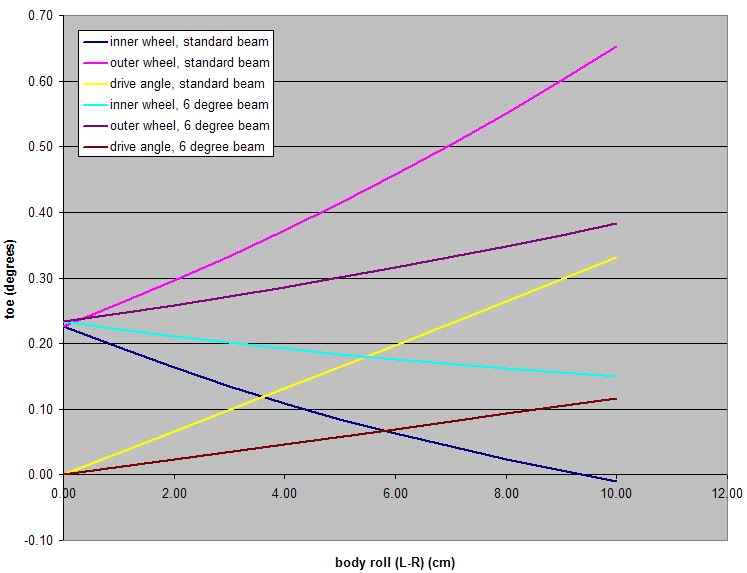
The big change in drive angle on the standard rear beam is also the reason why the car can be hard to drift. Getting the car to drift is more difficult due to the understeer. But when the car is already oversteering, the front wheels are pointing the other way (opposite lock) than the rear wheels. When the car stops oversteering this means it will try to make the car spin, which explains the 'snaking' behaviour.